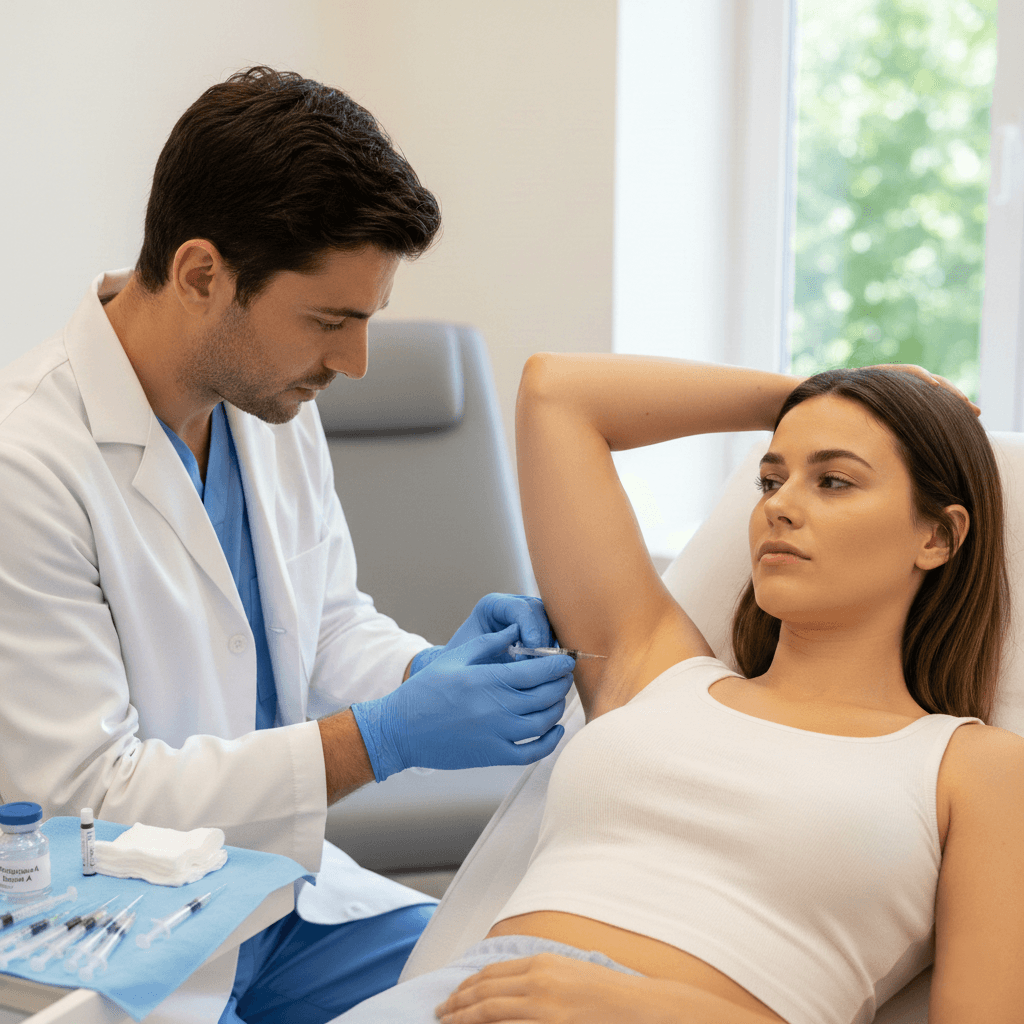
Hyperhidrosis treatment uses botulinum toxin injections to temporarily block sweat gland signals, reducing excessive sweating by 80–90% in treated areas.
Last updated: 29 March 2026
Quick Facts
Injectable
Cost Range
€400–€800 per area
Treatment Time
20-40 minutes
Pain Level
Underarms tolerable with topical numbing or ice; palms and soles significantly more uncomfortable and often treated under wrist/ankle nerve blocks, vibration devices, or inhaled nitrous oxide
Recovery Time
None — return to normal activities immediately (avoid strenuous exercise and heat exposure for 24 hours)
Results Last
6-9 months for underarms; 4-6 months for palms, soles, and face/scalp; some patients find duration lengthens with repeat treatments
Time to Results
Reduction begins at day 3-7; full effect by 2 weeks
Educational content only: This page summarises publicly available information for educational purposes and is not medical advice. SafeSkin does not recommend any specific practitioner, clinic, product, or treatment. Individual results vary. Always consult a registered healthcare professional before any treatment decision. See our full disclaimer.
Hyperhidrosis is a medical condition characterised by excessive sweating that significantly exceeds the body's normal thermoregulatory requirements. It affects an estimated 3% to 5% of the population, and for those who suffer from it, the impact on daily life, confidence, social interactions, and emotional wellbeing can be profound.
Hyperhidrosis treatment with botulinum toxin, the same active ingredient used in anti-wrinkle injections, is one of the most effective and well-established treatments for this condition. By temporarily blocking the nerve signals that activate sweat glands, botulinum toxin can reduce sweating in the treated area by 80% to 90%, providing transformative relief for sufferers.
The condition manifests in two main forms:
Primary focal hyperhidrosis is the most common form, affecting specific areas of the body, most frequently the underarms (axillary hyperhidrosis), palms (palmar hyperhidrosis), soles of the feet (plantar hyperhidrosis), and face or scalp (craniofacial hyperhidrosis). It typically begins in adolescence or early adulthood, often has a genetic component, and occurs regardless of temperature or emotional state. Primary focal hyperhidrosis is the form most commonly treated with botulinum toxin.
Secondary generalised hyperhidrosis is excessive sweating caused by an underlying medical condition (such as thyroid disorders, diabetes, menopause, infections, or neurological conditions) or by medications. This form requires investigation and treatment of the underlying cause, though botulinum toxin may still be used as a symptomatic treatment in some cases.
In Ireland, hyperhidrosis treatment is offered at medical aesthetic clinics, dermatology practices, and some GP clinics in Dublin, Cork, Galway, Limerick, and other cities. While it sits within the aesthetic injectable category (using the same botulinum toxin products), hyperhidrosis treatment is fundamentally a medical treatment that addresses a genuine medical condition with significant quality-of-life impact. Many patients describe meaningful improvement, enabling them to wear the clothes they want, shake hands confidently, and participate in social situations without the constant anxiety of visible sweating. Hyperhidrosis is also associated with elevated rates of anxiety and social phobia, and treatment can substantially improve psychological wellbeing in addition to physical symptoms.
First-line treatment first. Before considering botulinum toxin, international guidelines recommend a trial of prescription-strength aluminium chloride antiperspirants, available over the counter in Ireland as Driclor or Anhydrol Forte. Many patients find these effective when used correctly, and they represent a far more affordable first-line approach. Botulinum toxin is positioned as a second-line treatment for patients whose sweating is not adequately controlled by topical antiperspirants.
HSE access for severe cases. In Ireland, botulinum toxin treatment for severe axillary hyperhidrosis may be available through the HSE via dermatology clinics for patients meeting specific severity criteria. A GP referral to dermatology is typically required. Private treatment offers faster access and treats a wider range of areas (palms, soles, face, scalp) that may not be available on the public pathway.
The use of botulinum toxin for hyperhidrosis is well-supported by clinical evidence, with multiple randomised controlled trials demonstrating its efficacy and safety. It has been approved for axillary hyperhidrosis since the early 2000s and is endorsed by international guidelines as a second-line treatment after topical antiperspirants.
Botulinum toxin for hyperhidrosis works through the same fundamental mechanism as its cosmetic application for wrinkles, but targets a different type of nerve-muscle communication.
The sweating mechanism:
Normal sweating is controlled by the sympathetic nervous system. When the body needs to cool itself, nerve fibres release a chemical messenger called acetylcholine at the junction between the nerve and the eccrine sweat gland. Acetylcholine binds to receptors on the sweat gland cells, triggering them to produce sweat. In primary focal hyperhidrosis, this signalling pathway is overactive, the nerves release excessive acetylcholine, causing the sweat glands to produce far more sweat than the body needs for thermoregulation.
How botulinum toxin intervenes:
Botulinum toxin is a neurotoxin produced by the bacterium Clostridium botulinum. When injected into the skin in the affected area. It is taken up by the nerve terminals that supply the sweat glands. Inside the nerve terminal, the toxin cleaves specific proteins (SNARE proteins) that are essential for the release of acetylcholine vesicles. With these proteins disrupted, the nerve can no longer release acetylcholine, and the sweat gland does not receive the signal to produce sweat.
Importantly, the sweat glands themselves are not damaged or destroyed. They are simply temporarily unable to receive their activation signal. The nerve endings eventually regenerate and form new connections (a process called axonal sprouting), which is why the effect wears off after several months and repeat treatment is needed.
The treatment process:
Assessment: Your practitioner evaluates the severity and distribution of your sweating. For underarm treatment, a starch-iodine test (Minor's test) may be performed to map the exact areas of maximum sweat gland activity.
Preparation: The treatment area is cleansed. For underarm treatment, you should have shaved the area 1 to 2 days before (not immediately before, as shaving can irritate the skin). A topical anaesthetic cream may be applied. Particularly for palm or foot treatment.
Injection: Using a very fine needle, small amounts of botulinum toxin are injected intradermally (into the skin itself. Not the underlying muscle) in a grid pattern across the treatment area. The injections are placed approximately 1 to 2cm apart to ensure even coverage.
Underarms: Typically 50 units per axilla (100 units total), injected at 10 to 15 points per side
Palms: Typically 50 to 100 units per palm, injected at 15 to 20 points per palm
Feet: Similar dosing to palms, with 15 to 20 injection points per sole
Post-treatment: No dressing is required. You can return to normal activities immediately (with minor restrictions for 24 hours).
Key difference from cosmetic use:
In anti-wrinkle injections, botulinum toxin is injected into facial muscles to reduce movement that causes wrinkles. In hyperhidrosis treatment, the toxin is injected more superficially, into the dermis rather than the muscle, because the target is the nerve endings that supply the sweat glands, which sit within the skin itself.
What to Expect
Before Your Treatment
Before considering botulinum toxin, most guidelines recommend a trial of prescription-strength aluminium chloride antiperspirants (Driclor, Anhydrol Forte, Perspirex) available over the counter in Ireland — many patients find these effective when used correctly. If treating underarms, shave the area 1 to 2 days before (not on the day, as shaving can irritate the skin). Avoid antiperspirant on the day of treatment. Disclose all medications and supplements, particularly aminoglycoside antibiotics and certain muscle relaxants or anticholinergics that can potentiate botulinum toxin, along with any neuromuscular disorders, bleeding disorders, or known allergies to components of the botulinum toxin formulation (which includes human albumin).
During Your Treatment
A starch-iodine test (Minor’s test) may be performed to map the active sweating zones for precision. The treatment area is cleansed and marked with a grid pattern of injection points 1 to 2cm apart. A very fine needle is used to inject small amounts of botulinum toxin intradermally — into the skin itself rather than the underlying muscle — at each point. Underarm treatment involves around 10 to 15 points per side (50 units per axilla) and is typically well tolerated with topical numbing or ice. Palmar and plantar treatments are significantly more uncomfortable; nerve blocks (wrist or ankle blocks), ice, vibration devices, or inhaled nitrous oxide may be used. The full appointment takes 20 to 40 minutes.
After Your Treatment
You can return to normal activities immediately, avoiding strenuous exercise, hot baths, saunas, and steam rooms for 24 hours. Sweat reduction typically begins at day 3 to 7, with full effect by 2 weeks. Expect an 80 to 90 per cent reduction in underarm sweating, with somewhat lower but still significant reduction for palms and feet (typically 50 to 80 per cent). Duration is 6 to 9 months for underarms and 4 to 6 months for palms, soles, and face/scalp. Some patients find the duration increases with repeated treatments over years.
Who Is It Suitable For?
Ideal Candidates
Excessive underarm sweating not controlled by prescription-strength antiperspirants
Palmar (hand) or plantar (foot) sweating affecting work, social life, or daily function
Craniofacial (forehead/scalp) sweating affecting professional or social situations
Primary focal hyperhidrosis with significant quality-of-life impact, including associated anxiety or social phobia
Who Should Avoid
Pregnancy and breastfeeding
Active skin infection in the treatment area
Known allergy to any component of the botulinum toxin formulation (which includes human albumin)
Neuromuscular disorders such as myasthenia gravis, Lambert–Eaton syndrome, or motor neurone disease
Certain medications, including aminoglycoside antibiotics, which should be discussed with your practitioner before treatment
Secondary hyperhidrosis from an underlying medical condition — the underlying cause should be addressed first
#How Much Does Hyperhidrosis Treatment Cost in Ireland?
Private hyperhidrosis treatment in Ireland typically falls in these ranges per session, per area:
Underarms (axillary): €400 to €700
Palms (palmar): €500 to €800
Soles of the feet (plantar): €500 to €800
Face or scalp (craniofacial): €400 to €700
Combined-area treatments may be offered at package pricing. Costs vary with the specific product and total units used. The practitioner's experience, and the clinic's location.
A note on ongoing cost. Hyperhidrosis treatment is not a cure. It requires repeat sessions every 4 to 9 months depending on the area. Over 5 years, total treatment costs can accumulate significantly. Some patients find the duration of effect increases with repeated treatments over time, reducing the frequency needed.
Tax relief. Unlike purely cosmetic treatments, hyperhidrosis treatment addresses a medical condition and may qualify for tax relief in Ireland when prescribed and administered by a registered medical practitioner. Keep your receipts and consult your tax adviser for guidance specific to your circumstances.
Before or alongside botulinum toxin, several alternative treatments are worth understanding:
Prescription-strength topical antiperspirants. Products containing 20 to 25 per cent aluminium chloride (Driclor, Anhydrol Forte, Perspirex) are the first-line recommended treatment. Available over the counter in Ireland. They are far more affordable than botulinum toxin and effective for many patients when used correctly.
Tap water iontophoresis. An electrical current is passed through water on the hands or feet, temporarily reducing sweat gland activity. Home devices (Idromed, Hidrex) are available, and iontophoresis is particularly effective for palmar and plantar hyperhidrosis. Some patients use it alongside or instead of botulinum toxin.
Oral medications. Anticholinergics such as oxybutynin or glycopyrrolate can reduce sweating systemically but have side effects including dry mouth, blurred vision, and constipation. These are prescription-only and typically considered when topical and injection-based options are insufficient.
MiraDry (microwave thermolysis). This technology uses microwave energy to permanently destroy underarm sweat glands. Availability in Ireland has been limited and variable, confirm with individual clinics before assuming it is offered.
Endoscopic thoracic sympathectomy (ETS). For severe palmar hyperhidrosis refractory to other treatments, surgical ETS is sometimes considered. It is effective but carries a significant risk of compensatory sweating elsewhere on the body, which is often worse than the original problem. Generally a last-resort option after other approaches have failed.
Hyperhidrosis can affect various parts of the body, and botulinum toxin treatment can be targeted to the specific areas causing distress. Here is a detailed look at each common treatment zone.
Underarms (axillary hyperhidrosis):
This is the most commonly treated area and the one with the most extensive clinical evidence. Axillary hyperhidrosis causes excessive underarm sweating that soaks through clothing, causes visible sweat patches, stains garments, and generates significant social embarrassment.
Underarm treatment is the most straightforward:
Relatively large, flat treatment area that is easy to inject
Moderate pain level. Most patients tolerate it well with topical numbing
Excellent response rate, 80% to 90% sweat reduction in most patients
Typical duration of effect: 6 to 9 months
The starch-iodine test is particularly useful here to map the active sweating zones precisely
Palms (palmar hyperhidrosis):
Sweaty palms can be particularly disabling, affecting handshakes, the ability to grip objects, handling papers, using touchscreen devices, and many professional activities. Treatment of the palms is effective but more technically demanding and is significantly more uncomfortable than axillary treatment, even with pain management, patients should be prepared for this and discuss options with their practitioner in advance:
The palms have a much higher density of nerve endings, making injections notably painful
Nerve blocks (wrist blocks using local anaesthetic) are commonly used for pain control but require specific training. Some clinics use ice, vibration devices, or inhaled nitrous oxide (Pro-Nox) instead. Nerve blocks themselves can be uncomfortable and carry small risks such as intravascular injection or nerve injury.
The injection technique requires careful, superficial placement to avoid affecting the small muscles of the hand
Response rates are good (50% to 80% sweat reduction with clinically meaningful improvement in the majority), though slightly lower than underarm treatment
Duration of effect may be slightly shorter: 4 to 6 months
Temporary grip weakness or fine motor difficulties (pinch-grip weakness affecting writing, buttoning clothes, or handling small objects) can occur for 1 to 3 weeks, an important consideration for patients whose work requires fine dexterity
Soles of the feet (plantar hyperhidrosis):
Sweaty feet cause slipping in shoes, foot odour, skin maceration, and increased risk of fungal infections. Treatment is similar in approach to palmar treatment:
The soles are also highly innervated, making treatment uncomfortable
Nerve blocks (ankle blocks) can be used for anaesthesia
Walking may be slightly uncomfortable for 24 to 48 hours after treatment due to the injection sites
Response rates are similar to palm treatment
Duration of effect: 4 to 6 months
Forehead and scalp (craniofacial hyperhidrosis):
Excessive facial or scalp sweating causes hair to become wet, makeup to run, and sweat to drip visibly. Particularly distressing in social and professional settings. Treatment requires:
Very superficial injection technique to avoid affecting the underlying facial muscles (which could affect facial expression)
Lower doses per injection point
An experienced practitioner who understands the facial anatomy to avoid unwanted effects
Good results but requires careful technique
Other areas:
Some practitioners also treat the groin area, submammary fold (under the breasts), and the back for localised hyperhidrosis. These are less common but can be very effective for patients with sweating in these specific zones.
Impact on body temperature:
A common concern is whether blocking sweat in one area will affect the body's ability to cool itself. The treated area represents only a small fraction of the body's total sweat gland population. The body has approximately 2 to 4 million sweat glands, so treating one or two specific zones does not meaningfully impair thermoregulation. Patients can exercise, be in warm environments, and live normally without any temperature regulation issues.
The treatment process is relatively quick and straightforward. Particularly for underarm treatment.
Step-by-step procedure (underarm treatment as the example):
Preparation (5–10 minutes): You will be positioned comfortably with your arms raised. The treatment area is cleansed with an antiseptic solution. If a starch-iodine test is being performed, iodine solution is applied and allowed to dry, then starch powder is dusted over the area. After a few minutes, the sweating zones appear as dark blue-black areas, providing a precise treatment map.
Optional numbing: A topical anaesthetic cream may be applied 15 to 20 minutes before injection, or ice packs may be used immediately before to reduce discomfort. Many patients tolerate underarm treatment without any numbing. For palm or foot treatment, nerve blocks (local anaesthetic injections) are often administered.
Marking: The treatment area is divided into a grid pattern, with injection points marked approximately 1 to 2cm apart. For underarms, this typically results in 10 to 15 injection points per side.
Injection (10–20 minutes): Using a very fine needle (30 or 32 gauge), small amounts of reconstituted botulinum toxin are injected intradermally (into the skin) at each marked point. The injections are superficial, just a few millimetres into the skin, targeting the dermal level where the nerve-sweat gland junctions reside. A small bleb (raised bubble) at each injection point confirms correct placement in the dermis.
Underarms: Each side typically receives 50 units of botulinum toxin distributed across 10 to 15 injection points. Total treatment: approximately 100 units.
Palms: Each palm typically receives 50 to 100 units distributed across 15 to 20 injection points. The injection technique must be carefully controlled to avoid deep placement that could affect hand muscles.
Feet: Similar to palms in dosing and technique.
Post-injection (2–5 minutes): Gentle pressure is applied with gauze to any bleeding points. No dressing or bandage is needed. Your practitioner will review the aftercare instructions.
Comfort level:
Underarm treatment involves mild stinging at each injection point. Most patients find it very tolerable. The entire injection phase takes only 10 to 15 minutes. Palm and foot treatments are more uncomfortable due to the high nerve density in these areas, but nerve blocks significantly improve comfort. Most patients would rate underarm treatment as 2 to 3 out of 5 for discomfort, and palm/foot treatment as 3 to 4 out of 5 (with nerve block).
Total appointment time:
Expect 20 to 40 minutes for the full appointment, including preparation, any numbing time, and the injection process itself.
Benefits and Risks
Key Benefits
Typically 80 to 90 per cent reduction in underarm sweating; somewhat lower but still significant reduction for palms and feet
Meaningful improvement in quality of life, with reduced anxiety and social avoidance for many patients
Quick, well-tolerated procedure (particularly for underarms)
No downtime — immediate return to normal activities
Potential Risks
Mild bruising at injection sites
Temporary grip weakness or fine motor difficulties after palmar treatment (typically 1 to 3 weeks) — an important consideration for those whose work requires fine dexterity
Compensatory sweating elsewhere on the body is very rare with botulinum toxin (in contrast to surgical sympathectomy, where it is common)
Rare: systemic effects including generalised muscle weakness, dry mouth, or difficulty swallowing (more likely with high total doses or repeat treatments)
Results are temporary and wear off over months, requiring repeat treatment every 4 to 9 months
Understanding when to expect results and how long they last helps manage expectations.
Days 1–3:
Most patients do not notice significant change in the first few days. The botulinum toxin needs time to be taken up by the nerve terminals and to exert its effect on the SNARE proteins.
Days 3–7:
The majority of patients begin to notice a meaningful reduction in sweating during this period. Some notice the effect as early as day 2; for others, it takes a full week.
Weeks 1–2:
The full effect develops. By two weeks post-treatment, the maximum sweat reduction should be apparent. Most patients experience an 80% to 90% reduction in sweating in the treated area. This can be truly transformative, patients often describe it as life-changing.
Months 1–4:
The treatment is at its peak effect. Sweating is dramatically reduced. Patients can wear light-coloured clothing, shake hands confidently, exercise without excessive sweat patches, and go about their daily lives without the constant anxiety of visible sweating.
Months 4–9:
Sweating gradually begins to return as the nerve endings regenerate. The return is gradual, sweating does not suddenly revert to pre-treatment levels. Most patients notice a slow increase in sweating and schedule their repeat treatment when the level becomes bothersome again.
Average duration by area:
Underarms: 6 to 9 months (some patients report up to 12 months)
Palms: 4 to 6 months
Feet: 4 to 6 months
Face/scalp: 4 to 6 months
Long-term outcomes with repeated treatment:
Some patients find that the duration of effect increases with repeated treatments over several years. This may be due to partial atrophy of the sweat glands from prolonged disuse. Patients who have been having regular treatments for several years sometimes report needing treatment only once or twice a year rather than every 4 to 6 months.
Measuring success:
Your practitioner may use the Hyperhidrosis Disease Severity Scale (HDSS) to measure improvement:
Score 1: Sweating is never noticeable and never interferes with daily activities
Score 2: Sweating is tolerable but sometimes interferes with daily activities
Score 3: Sweating is barely tolerable and frequently interferes with daily activities
Score 4: Sweating is intolerable and always interferes with daily activities
Most patients move from a score of 3 or 4 before treatment to a score of 1 or 2 after treatment, a clinically meaningful improvement that correlates with significant quality-of-life enhancement.
Selecting the right practitioner for hyperhidrosis treatment ensures accurate diagnosis, safe treatment, and optimal results.
Why practitioner choice matters:
Hyperhidrosis treatment is a medical procedure for a medical condition. Unlike purely cosmetic treatments. It requires:
Proper diagnosis and exclusion of secondary causes
Understanding of the specific injection technique for hyperhidrosis (which differs from cosmetic botulinum toxin use)
Knowledge of appropriate dosing for each treatment area
Ability to manage any complications
Understanding of alternative treatments and when to recommend them
Qualifications:
Doctors registered with the Medical Council of Ireland (dermatologists are particularly well suited, especially if an underlying medical cause needs to be excluded)
Dentists registered with the Dental Council of Ireland
Nurses registered with NMBI (Nursing and Midwifery Board of Ireland)
What to look for:
Medical expertise: A practitioner who treats hyperhidrosis as a medical condition, not merely a cosmetic concern. They should ask about the pattern, duration, and impact of your sweating, and consider whether secondary causes need investigation.
Experience with hyperhidrosis specifically: Ask how many hyperhidrosis patients the practitioner has treated. The injection technique for sweat glands differs from cosmetic use (more superficial placement, different injection pattern).
Diagnostic tools: A practitioner who uses the starch-iodine test (Minor's test) to map the treatment area demonstrates a thorough, precise approach.
Comprehensive consultation: Discussion of all treatment options, not just botulinum toxin. A good practitioner will have considered whether you have tried topical treatments first and may discuss iontophoresis, oral medications, or miraDry as alternatives.
Appropriate dosing: Ask about the number of units they use per area. Under-dosing is a common cause of suboptimal results.
Follow-up protocol: A good clinic will offer a follow-up review 2 to 4 weeks after treatment to assess the response and top up any under-treated areas if needed.
Red flags:
Treatment offered without any diagnostic assessment or medical history
No discussion of alternative treatments
Inability to explain the condition or the mechanism of treatment
Significantly below-market pricing (may indicate insufficient product being used)
No follow-up offered
Finding a verified clinic:
SafeSkin's directory allows you to find a verified clinic offering hyperhidrosis treatment in Ireland. All listed practitioners hold appropriate professional registration. You can search by location and treatment type to find a convenient, qualified provider near you.
Looking for Hyperhidrosis Treatment?
Every practitioner on SafeSkin is register-checked with the Medical Council of Ireland, the Dental Council, or NMBI. Find a qualified professional near you.
Underarms tolerable with topical numbing or ice; palms and soles significantly more uncomfortable and often treated under wrist/ankle nerve blocks, vibration devices, or inhaled nitrous oxide
Recovery Time
None — return to normal activities immediately (avoid strenuous exercise and heat exposure for 24 hours)
Results Last
6-9 months for underarms; 4-6 months for palms, soles, and face/scalp; some patients find duration lengthens with repeat treatments
Time to Results
Reduction begins at day 3-7; full effect by 2 weeks
We use essential cookies to make SafeSkin work. With your consent, we also use analytics cookies to improve the experience. Read our Cookie Policy for details.