
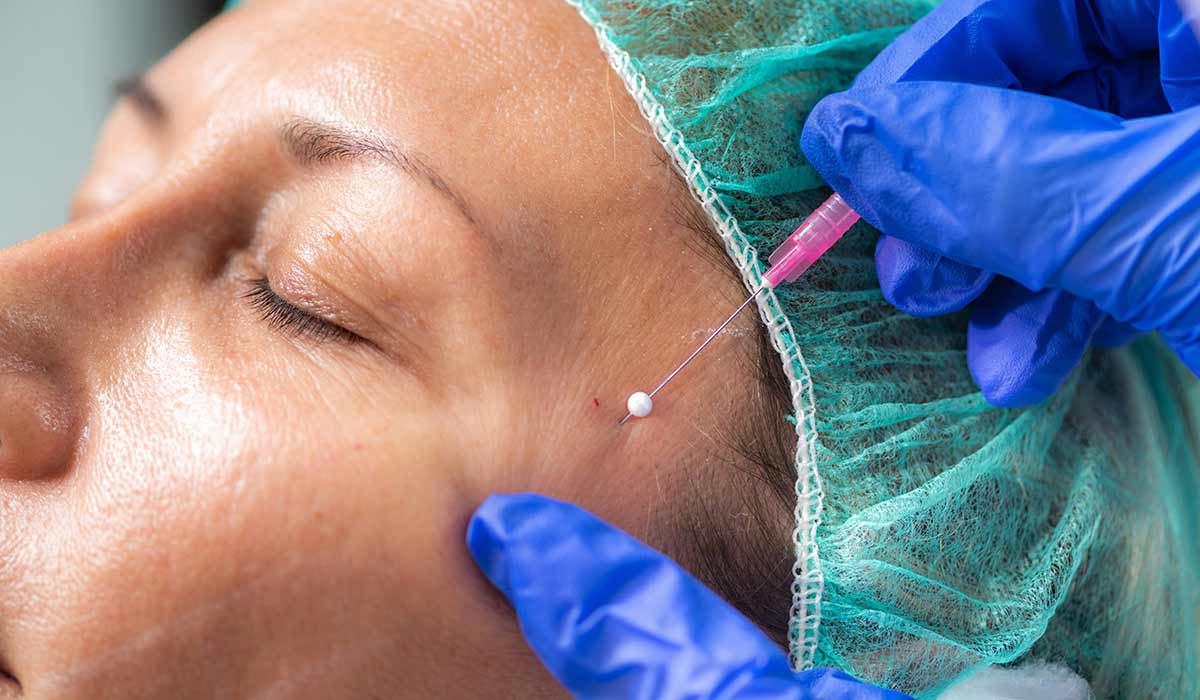
The thread lift is one of the fastest-growing treatments in Irish aesthetics, and its pitch is seductive: a visible lift without surgery, done in under an hour, at a fraction of a facelift's cost. Sometimes it is even called the "lunchtime facelift."
As ever, the reality is more nuanced than the nickname, and this is a treatment where understanding the nuance matters more than usual, because a thread lift is one of the more invasive things you can have done without an operating theatre.
This guide covers how thread lifts actually work, what they genuinely cost in Ireland, what results to realistically expect, and the questions to ask before anyone puts a thread near your face.
What a thread lift actually is
A thread lift uses dissolvable surgical threads, most commonly made of PDO (polydioxanone), a material used in surgical stitching for decades, inserted under the skin with a fine needle or cannula. Depending on the type, the threads either mechanically lift and reposition sagging tissue (barbed or "cog" threads that grip and pull) or simply sit in the skin as a scaffold (smooth "mono" threads).
Two things then happen. The lift itself is immediate: tissue is physically repositioned. And over the following months, the threads trigger the skin's repair response around them, stimulating new collagen, the same principle behind treatments like microneedling, which we explain in our guide to collagen and elastin.
The threads themselves dissolve over roughly six to nine months, leaving the collagen they provoked behind.
What it can and can't do
Thread lifts suit mild to moderate skin laxity: early jowling, a softening jawline, sagging in the mid-face or brow, loose skin on the neck. The typical result is a subtle lift and tightening, often described as looking fresher rather than visibly different, and results typically last somewhere between twelve and eighteen months as the tissue gradually settles and the collagen effect fades.
What a thread lift is not is a facelift. It cannot move significant sagging, it cannot remove excess skin, and it will not produce a surgical result. The honest positioning is a middle option: more structural than skin-quality treatments, far less dramatic and less lasting than surgery. People with significant laxity who buy the "lunchtime facelift" framing are the most commonly disappointed group, so realistic expectations, set by an honest practitioner, are half the treatment.
It is also not primarily a wrinkle or volume treatment. Movement lines remain anti-wrinkle injection territory and volume loss remains dermal filler territory; threads address the direction tissue is heading, not its fullness. That said, threads have found a moment in the current shift away from heavy filler towards subtler, structural approaches, part of the same rethink we covered in the great filler reversal.
What thread lifts cost in Ireland
Pricing varies more than most treatments, because "a thread lift" can mean anything from a few smooth threads in one area to a full-face lift with dozens of cogs. As a current Irish guide:
Smaller targeted areas (brow, a few mono threads): from roughly €300–€600.
Neck: around €800.
Full face: typically €1,500–€2,000.
Face and neck combined: around €2,000 and upwards.
Results lasting a year to eighteen months mean the cost per year sits well above anti-wrinkle injections and in similar territory to a substantial filler treatment, worth factoring in honestly when comparing options.
As always, a price dramatically below these ranges is information, not luck. Threads are priced partly on the skill required to place them, and that is the last corner worth cutting.
The risks nobody advertises
This is the section that matters most, because thread lifts sit at the invasive end of non-surgical treatments and their complication list reflects it.
Common and usually temporary: swelling, bruising, tenderness, and a tight or pulling sensation for days to weeks.
More significant and entirely technique-dependent: visible dimpling or puckering of the skin, asymmetry, threads that can be felt or, occasionally, seen under thin skin, thread migration or extrusion, infection, and, rarely, damage to nerves or salivary structures from poorly placed threads.
Correcting a badly done thread lift is genuinely difficult, sometimes requiring removal, which is far harder than insertion.
Every one of those risks scales with the skill and anatomical knowledge of the person holding the needle. Placing threads safely requires knowing exactly what lies beneath the skin at every point along the thread's path, which is surgical-level anatomy applied without a surgical setting.
And here is the fact to hold onto: in Ireland, no law restricts who can perform a thread lift.
Like fillers, threads fall outside the prescription-medicine rules, so the title on the door tells you nothing.
For a treatment this anatomy-dependent, that makes checking your practitioner's actual qualifications not a precaution but the entire decision. Our guide to choosing a qualified aesthetic practitioner covers how.
Questions to ask before you book
Five questions do the work. What are your medical qualifications and registration? How many thread lifts have you performed, and may I see healed results, not day-one photos? What type and how many threads are you proposing, and why for my face? What happens if I get dimpling, migration, or want them removed? And, the honest filter, am I actually a good candidate, or would you recommend something else, or nothing?
A practitioner who welcomes that last question is the one to trust. Thread lifts have a well-earned place for the right candidate with the right hands, and a well-earned complication list for everyone else.
The bottom line
A thread lift offers something real: a subtle, immediate lift with a collagen dividend, no general anaesthetic, and a fraction of surgery's cost and downtime. It also demands more of its practitioner than almost any other non-surgical treatment, in a country where the law demands nothing of them at all.
If sagging or early jowling is your concern and you want to explore whether threads, or something gentler, fits, our treatment quiz is a sensible starting point, and you can search register-verified clinics near you to find a practitioner whose qualifications are independently checked before you sit in anyone's chair.
Medically reviewed by Dr Stephen CreedonAll SafeSkin editorial content is reviewed by a registered medical professional before publication.