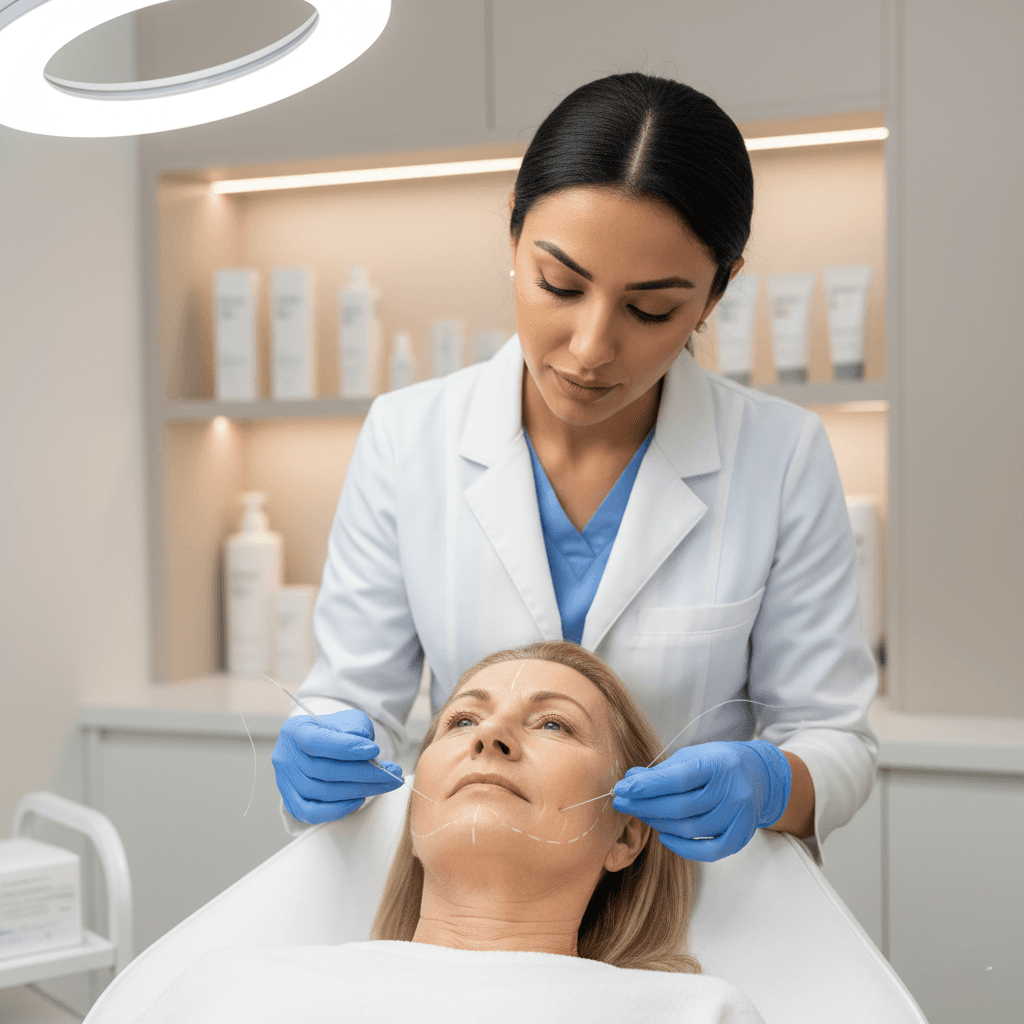
#What Is a Thread Lift?
A thread lift is a minimally-invasive cosmetic procedure that lifts and repositions sagging facial skin using specially designed medical-grade threads inserted beneath the skin's surface. It is often referred to as a "lunchtime facelift," but that branding significantly understates the recovery involved, despite marketing. Most patients experience meaningful swelling, bruising, and some restricted facial movement for 1 to 2 weeks, and the social calendar should be planned accordingly.
Thread lifts bridge the gap between non-invasive treatments like HIFU and surgical facelifts, offering a more pronounced immediate lifting effect than energy-based devices without the commitment, cost, and extensive recovery of surgery. That said, thread lifts typically provide a subtle to moderate lift of a few millimetres, meaningful, but significantly less than a surgical facelift, which typically achieves 1 to 2 centimetres of tissue repositioning. Set expectations accordingly.
In Ireland, thread lifts have grown significantly in popularity as more patients seek effective lifting solutions that do not require general anaesthesia or weeks of downtime. The treatment is particularly popular among patients in their late 30s to mid-50s who are noticing the early to moderate effects of facial sagging, softening of the jawline, jowl formation, drooping of the midface or cheeks, and brow heaviness.
Thread materials, what to know. Modern thread lifts use biocompatible, dissolvable materials with a long history of safe use in medicine (including surgical sutures):
- PDO (polydioxanone), dissolves in approximately 6 to 8 months
- PLLA (poly-L-lactic acid), dissolves over approximately 12 to 18 months, with stronger collagen stimulation
- PCL (polycaprolactone), dissolves over up to 24 months, with the most sustained collagen stimulation
Collagen stimulation continues after the threads themselves dissolve, which is why PLLA and PCL threads tend to cost more and are sometimes preferred by practitioners for durable results.
Barbed vs smooth threads, an important distinction. Only barbed or cog threads physically reposition tissue and provide a structural lift. Smooth monofilament threads (sometimes called "mono threads") primarily stimulate collagen without providing a physical lift. Some clinics market treatments with only smooth threads as "thread lifts," which they aren't in the structural sense. Always clarify which type of thread is being used and what it will realistically achieve.
A thread lift is a genuine medical procedure. Not a "beauty treatment", and should only be performed by a qualified medical professional with specific training in thread insertion techniques and detailed knowledge of facial anatomy. Outcomes vary between practitioners more than for almost any other non-surgical treatment: poor technique can result in thread migration, asymmetry, dimpling, and suboptimal lifting. Practitioner selection matters enormously.
#How Does a Thread Lift Work?
A thread lift works through two complementary mechanisms: the immediate mechanical lifting of tissue, and the longer-term stimulation of collagen production around the threads. Here is how the procedure typically unfolds:
-
Consultation and planning, Your practitioner conducts a thorough facial assessment, examining your degree of laxity, skin quality, facial anatomy, and overall facial proportions. They will mark the entry and exit points for the threads and plan the exact trajectory of each thread to achieve the desired lifting effect. Pre-treatment photographs are taken.
-
Preparation, The treatment area is cleansed with an antiseptic solution. Local anaesthetic is injected along the planned thread pathways to numb the area completely. This is the most uncomfortable part of the procedure for most patients.
-
Thread insertion, Using a thin cannula or needle. The practitioner inserts each thread beneath the skin along the predetermined pathway. For lifting threads (barbed or cog threads), the thread is inserted at the entry point, guided along the tissue plane, and the barbs or cogs engage with the tissue as the thread is pulled, physically repositioning the skin upward.
-
Tensioning and positioning, Once all threads are in place. The practitioner gently tensions them to achieve the optimal lifting effect. This step requires significant skill and aesthetic judgement, the lift must look natural, symmetrical, and not overdone.
-
Trimming and settling, The excess thread material is trimmed at the entry points, which are typically small puncture marks or tiny incisions that heal over days to weeks, though faint marks may occasionally remain longer. The threads sit entirely beneath the skin and are not usually visible or palpable once settled.
-
Completion, The treated area is cleaned, and aftercare instructions are provided. No sutures or dressings are typically required, though some practitioners apply small adhesive strips at the entry points.
The entire procedure takes approximately 45 to 90 minutes, depending on the number of threads used and the areas being treated. The number of threads varies widely, a targeted jawline lift might use 4 to 6 threads, while a comprehensive full-face treatment could involve 12 to 20 or more threads.
Immediate appearance, with a caveat. Thread lifts provide visible lifting immediately, but initial swelling typically exaggerates the lift and can make the early result look over-corrected. The true final result emerges once swelling settles over 1 to 2 weeks. Over the following 2 to 3 months, the collagen stimulation effect builds, revealing a lifted, more defined contour that should look natural and refreshed. When viewing a practitioner's before/after photos, ask to see images taken at 1 to 3 months post-treatment, photos taken immediately after treatment are not a realistic guide to the final result.
#Recovery and Aftercare
Thread lift aftercare matters more than for most non-surgical treatments, because the threads need to anchor in the tissue without being disturbed:
- Sleep on your back for 1 to 2 weeks to avoid pressure on treated areas and prevent thread displacement.
- Avoid wide mouth opening (including yawning, loud laughing, aggressive chewing) for 2 weeks. Eat soft foods and be cautious with facial expressions during the initial healing period so the threads can anchor properly.
- Avoid facial massage, facials, aggressive cleansing, and other facial treatments for at least 4 to 6 weeks after the procedure.
- Avoid strenuous exercise for 1 to 2 weeks to prevent bleeding, swelling, and thread displacement.
- Plan for social downtime of 1 to 2 weeks, meaningful swelling and bruising are common in the early days.
- Dental work should be avoided for 2 weeks before and after the procedure. Dental procedures involve jaw manipulation, potential facial oedema, and bacterial exposure that could compromise thread placement or cause infection at the treatment site.
Dimpling at entry points is usually temporary and resolves within 1 to 2 weeks. Persistent dimpling may indicate thread placement issues and should prompt a review with your practitioner.
A note on reversibility. Unlike hyaluronic acid fillers, thread lifts are not easily reversible. Threads can be removed surgically if complications arise, but this is an additional procedure and may not fully restore the original tissue position. This is important informed-consent information to understand before proceeding.
Combining with other treatments. Thread lifts are typically performed first, then other treatments (fillers, HIFU, Profhilo, energy-based devices) are performed weeks later once the threads have anchored. Simultaneous treatments may compromise thread placement or complicate assessment.
#How Much Does a Thread Lift Cost in Ireland?
Thread lifts are among the more expensive non-surgical aesthetic treatments available in Ireland, reflecting the skill required, the cost of the medical-grade threads, and the medical nature of the procedure. Prices typically range from €800 to €2,500 per session, influenced by the following factors:
- Number of threads, This is the primary cost driver. A targeted treatment using 4 to 6 threads (e.g., jawline only) costs less than a comprehensive treatment using 12 to 20 threads across multiple areas.
- Type of threads, PLLA and PCL threads, which last longer and produce more sustained collagen stimulation, tend to be more expensive than PDO threads. Premium branded threads (such as Silhouette Soft, MINT, or Aptos) may also carry a price premium.
- Treatment area and complexity, Simple jawline or brow treatments are at the lower end, while full-face and neck treatments are at the higher end. Revision procedures may cost more due to the added complexity.
- Practitioner experience, Thread lifts are highly technique-dependent, and experienced practitioners with extensive training typically charge more. This is a procedure where paying for experience is particularly worthwhile.
- Clinic location, Dublin clinics tend to be at the higher end of the price range.
Most thread lifts provide results lasting 12 to 18 months, though PDO-only treatments may last closer to 6 to 12 months. Duration depends on thread type, the number used, individual collagen response, and lifestyle factors. Most patients require a single session. When comparing costs with other treatments, consider that a thread lift provides an immediate structural lift that non-invasive treatments cannot match.
Payment plans, Many clinics offer interest-free payment plans, which can make this premium treatment more accessible.
You can search for verified clinics on SafeSkin.ie to compare thread lift providers and pricing across Ireland.
#Thread Lift vs Alternative Treatments
| Treatment | Best For | Duration of Results | Price Range (Ireland) | Downtime |
|---|
| Thread Lift | Immediate structural lift, jawline, midface | 12–18 months | €800–€2,500 per session | 3–7 days |
| HIFU | Gradual deep lifting, skin tightening | 12–24 months | €500–€1,500 per session | None to minimal |
| Dermal Fillers | Volume restoration, contouring | 6–18 months | €250–€500 per syringe | None to minimal |
| Profhilo | Skin quality, hydration, mild laxity | 6–9 months | €250–€450 per session | None to minimal |
Thread lifts offer the most pronounced immediate lifting effect of any non-surgical option. HIFU provides a gentler, more gradual lift with no downtime but cannot physically reposition tissue. Dermal fillers restore volume and can create the illusion of lift through strategic placement but do not physically lift sagging tissue. Many practitioners recommend combining treatments, for example, thread lift for structural lift, fillers for volume, and HIFU or Profhilo for skin quality.
#How to Choose a Provider in Ireland
Choosing the right practitioner for a thread lift is arguably more critical than for any other non-surgical aesthetic treatment. The procedure is highly technique-dependent, and the skill of the practitioner directly determines both the safety and the quality of the outcome.
Qualifications:
- Doctors registered with the Medical Council of Ireland
- Dentists registered with the Dental Council of Ireland
- Nurses registered with NMBI (Nursing and Midwifery Board of Ireland) with specific advanced training in thread insertion
This is not a treatment that should be delegated to non-medically qualified staff. SafeSkin.ie verifies the registration status of all listed practitioners.
Specific thread lift training, Beyond basic medical qualifications, your practitioner should have specific training in thread lift techniques from a recognised training provider or manufacturer. Ask about their training background and how many thread lift procedures they have performed. Experience matters enormously with this treatment.
Consultation quality, A thorough consultation is non-negotiable. Your practitioner should assess your facial anatomy, degree of laxity, skin quality, and overall facial proportions. They should discuss realistic expectations, explain the specific threads they plan to use and why, and walk you through the risks and recovery in detail.
Before and after portfolio, Ask to see before and after photographs of the practitioner's own patients, not stock images from the thread manufacturer. These photographs give you the most realistic indication of what to expect from that specific practitioner.
Red flags to watch for:
- Non-medically qualified practitioner performing the procedure
- No consultation or a rushed assessment
- Unrealistic claims (e.g., "better than a facelift" or "no downtime")
- Very low pricing, this may indicate inferior threads, inadequate training, or both
- Pressure to proceed immediately without time to consider
- No before and after photographs of their own work
You can search for verified clinics on SafeSkin.ie to find thread lift providers near you with verified medical credentials.