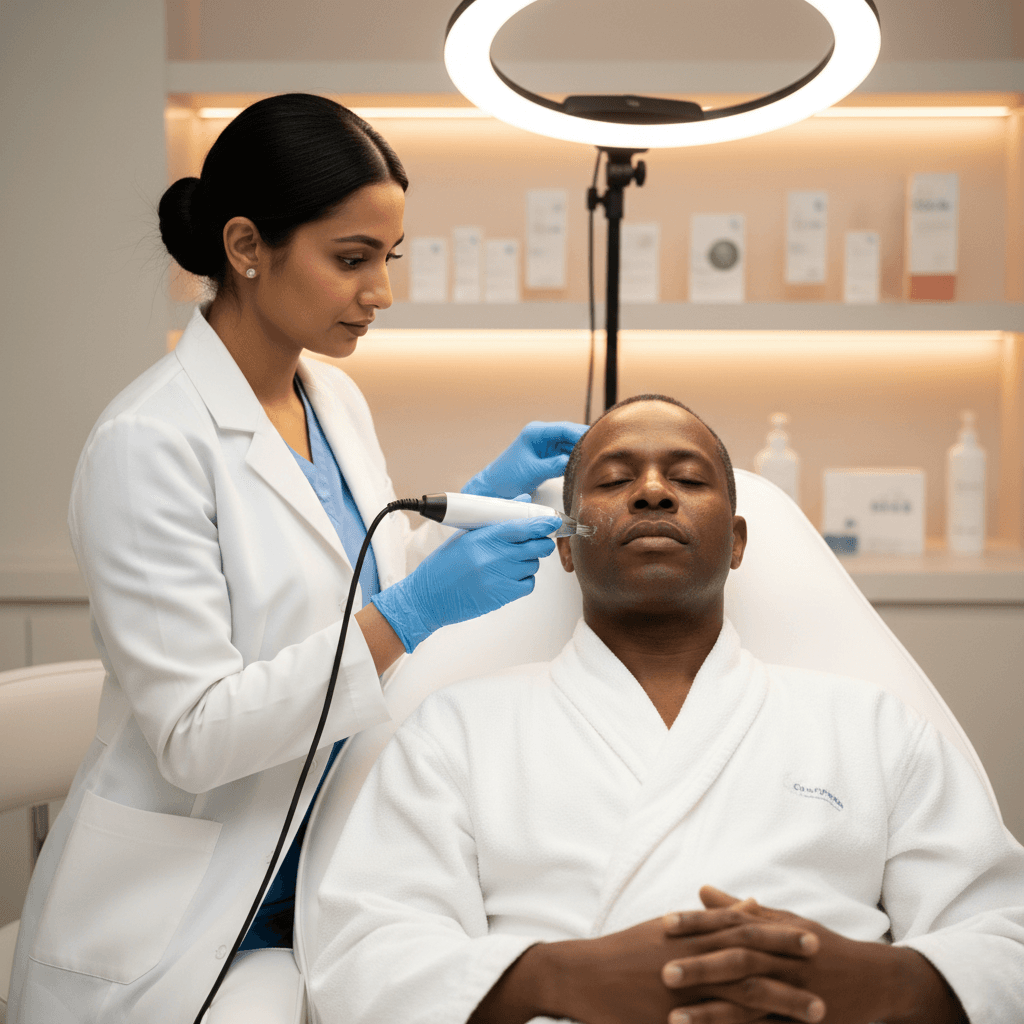
#What Is Microneedling?
Microneedling, also known as collagen induction therapy (CIT) or percutaneous collagen induction (PCI), is a minimally invasive skin rejuvenation treatment that uses a device equipped with fine, sterile needles to create thousands of tiny, controlled punctures (micro-channels) in the skin's surface. These micro-injuries trigger the body's natural wound-healing response, stimulating the production of new collagen and elastin, the structural proteins that give skin its firmness, elasticity, and youthful appearance.
In Ireland, microneedling has established itself as one of the most popular and effective skin rejuvenation treatments available. It is valued for its versatility and its ability to deliver meaningful, visible improvement in skin quality. Microneedling is considered safer than laser resurfacing for darker skin types (Fitzpatrick IV to VI), though post-inflammatory hyperpigmentation (PIH) remains a risk in these skin tones and must be managed with appropriate technique and aftercare, sun protection in particular is essential.
The treatment is particularly effective for improving acne scarring, reducing fine lines and wrinkles, refining skin texture and pore size, and enhancing overall skin firmness and radiance. It is also used to improve the appearance of stretch marks, surgical scars, and certain types of pigmentation. Patients with melasma should discuss this with their practitioner, as microneedling can sometimes worsen melasma.
Professional microneedling is performed using medical-grade devices such as the SkinPen, Dermapen, or Exceed, motorised pen-like instruments that drive needles into the skin at controlled depths with precision and consistency. Depth is selected based on the treatment area and concern, typically 0.25 to 0.5 mm for delicate areas like under-eyes, 0.5 to 1.5 mm for general facial rejuvenation, and up to 2 to 2.5 mm for body treatments such as stretch marks or deeper scarring.
Home derma rollers are fundamentally different: they use shorter needles, cannot achieve consistent depth, are typically not single-use or fully sterile, and carry risks of contamination, uneven treatment, and scarring. They should not be considered equivalent to professional treatments.
The controlled micro-injuries created by microneedling initiate a three-phase healing process: inflammation (the body sends healing signals to the area), proliferation (new collagen, elastin, and blood vessels form), and remodelling (the new tissue matures and strengthens over months). This natural regenerative process is what makes microneedling so effective for long-term skin improvement.
#How Does Microneedling Work?
A professional microneedling treatment typically takes 30 to 60 minutes and follows a structured process.
Consultation and assessment: Before your first session, your practitioner will assess your skin type, concerns, and medical history. They will determine the appropriate needle depth and treatment parameters for your specific needs and create a personalised treatment plan.
Preparation: On the day of treatment, your skin is thoroughly cleansed and a topical anaesthetic cream (typically containing lidocaine and prilocaine) is applied 20 to 30 minutes before the procedure. This ensures comfort during the treatment.
The microneedling procedure:
- The anaesthetic is removed and the skin is cleansed again
- A hyaluronic acid serum or other appropriate glide medium is applied to the skin surface
- The practitioner passes the microneedling device across the treatment area in a systematic pattern, ensuring even coverage
- The device creates thousands of micro-channels at the predetermined depth, typically 0.25 to 0.5 mm for delicate areas like under-eyes, 0.5 to 1.5 mm for general facial rejuvenation, and up to 2 to 2.5 mm for body treatments such as stretch marks or deep scarring
- Multiple passes may be made over areas of particular concern
- If PRP therapy is being combined with the treatment, the platelet-rich plasma is applied during or immediately after the microneedling to penetrate through the open channels
Post-treatment: A calming serum or mask is applied, followed by a hydrating moisturiser and SPF. Your practitioner will provide aftercare instructions.
The science of healing: Over the following weeks, the controlled micro-injuries trigger a cascade of biological events. Fibroblasts (the cells that produce collagen) are activated, and new collagen is produced, with the initial type III collagen expected to remodel into more durable type I collagen over 3 to 6 months, consistent with normal skin healing. New elastin fibres form, improving skin elasticity. Blood supply to the treated area increases, delivering nutrients and oxygen that support healthy skin function. This process of neocollagenesis (new collagen formation) is cumulative, each session builds upon the last, which is why a course of treatments delivers significantly better results than a single session.
#How Much Does Microneedling Cost in Ireland?
Microneedling is one of the more affordable professional skin rejuvenation treatments available in Ireland, offering excellent value relative to the results it can achieve.
Typical pricing:
- Standard microneedling (face): €150 to €350 per session
- Microneedling with PRP: €400 to €700 per session
- Microneedling with growth factor serums: €200 to €400 per session
- Body areas (stretch marks, scars): €200 to €450 per session
- Course of 3 sessions (face): €400 to €900 (package pricing)
- Course of 6 sessions (face): €750 to €1,600 (package pricing)
Factors that influence pricing:
- Treatment area and size. A full face treatment costs more than treating a small area of scarring. Combining face, neck, and décolletage increases the price accordingly.
- Combination with PRP or serums, adding PRP therapy significantly increases the cost but also enhances results. Particularly for scarring and rejuvenation.
- Device used, medical-grade devices like the SkinPen (which holds both FDA clearance in the US and CE Mark in Europe, reflecting regulatory quality) may command a premium.
- Needle depth and treatment intensity, deeper, more aggressive treatments for scarring require more expertise and time.
- Practitioner experience, doctors with specialist dermatology or aesthetic medicine training may charge more.
- Clinic location, Dublin practices tend to have higher pricing, though excellent practitioners are found throughout Ireland.
Package pricing is widely available and typically offers savings of 10 to 20 per cent compared with paying per session. Given that 3 to 6 sessions are recommended for optimal results, package pricing represents good value.
You can search for verified clinics on SafeSkin.ie to compare microneedling providers and pricing in your area.
#Microneedling vs Alternative Treatments
| Treatment | Best For | Typical Maintenance Interval | Price Range | Downtime |
|---|
| Microneedling | Scarring, texture, pores, fine lines | Every 3–6 months | €150–€350/session | 2–5 days |
| RF Microneedling | Skin tightening, deep scarring, laxity | Every 6–12 months | €300–€800/session | 3–7 days |
| Chemical Peels | Pigmentation, acne, dullness | Every 3–6 months (superficial); 1–3 years (medium/deep) | €100–€500/session | 1–14 days |
| Laser Skin Resurfacing | Deep wrinkles, severe scarring | Varies by type (see below) | €300–€1,500/session | 5–14 days |
A note on duration. For collagen-stimulating treatments (microneedling, RF microneedling, chemical peels, laser), the figures above refer to the typical interval between maintenance sessions. Not the point at which all results vanish. These treatments produce durable biological improvements in your own collagen. The skin continues to age naturally over time, which is why maintenance is recommended, results do not simply disappear on a deadline.
Microneedling vs RF microneedling: RF microneedling adds radiofrequency energy to the standard microneedling process. The RF energy heats the deeper layers of the skin, supporting collagen contraction (tightening) in addition to stimulating new collagen production. RF microneedling is often preferred for skin laxity, deep scarring, and patients who want both textural improvement and tightening. Standard microneedling is more affordable, has slightly less downtime, and is an excellent choice for texture, superficial scarring, and general rejuvenation.
Microneedling vs chemical peels: Chemical peels dissolve damaged skin layers chemically, while microneedling works mechanically. Chemical peels are generally better for pigmentation, active acne, and surface-level concerns. Microneedling is more effective for scarring, collagen building, and improving skin firmness. The two treatments complement each other and are often alternated in a comprehensive skin programme.
Microneedling vs laser skin resurfacing: Laser skin resurfacing uses focused light energy to remove damaged skin and stimulate deep collagen remodelling. Results vary significantly by laser type, fractional non-ablative lasers produce results typically maintained for 6 to 12 months, fractional ablative lasers 1 to 3 years, and fully ablative CO2 resurfacing up to 5 years. Ablative lasers can achieve more dramatic results in fewer sessions, but with significantly more downtime, higher cost, and greater risk. Particularly for darker skin tones. For patients with mild-to-moderate concerns, microneedling can achieve excellent results with a more favourable risk profile than some laser treatments. For more severe concerns, laser may be more appropriate, your practitioner can advise.
#How to Choose a Provider in Ireland
Choosing a qualified, experienced practitioner is crucial for safe and effective microneedling. While the treatment itself is relatively low risk, incorrect needle depth, poor technique, or inadequate hygiene can lead to complications.
Essential qualifications:
- Doctors registered with the Medical Council of Ireland
- Dentists registered with the Dental Council of Ireland
- Nurses registered with NMBI (Nursing and Midwifery Board of Ireland)
What to look for in a microneedling provider:
- Uses medical-grade, CE-marked or FDA-cleared microneedling devices (such as SkinPen, Dermapen 4, or Exceed)
- Conducts a thorough consultation including skin assessment and medical history review before any treatment
- Can explain the treatment parameters, needle depth, number of passes, products used, and tailor them to your individual needs
- Maintains strict infection control protocols, including single-use, disposable needle cartridges
- Provides before and after photographs of previous patients
- Offers transparent pricing and no-pressure consultations
- Provides detailed written aftercare instructions and follow-up contact information
Red flags to avoid:
- Use of non-medical-grade devices or reusable needle cartridges (infection risk)
- No consultation, skin assessment, or medical history taken before treatment
- Treatments offered in non-clinical environments without proper hygiene protocols
- Practitioners who are not registered with one of the Irish regulatory bodies
- Unrealistic promises about results or claims of permanent improvement from a single session
- Unusually low pricing that may indicate corner-cutting on equipment, products, or training
SafeSkin.ie verifies that all listed practitioners hold current registration with the appropriate Irish regulatory body. You can search for verified clinics on SafeSkin.ie to find a qualified microneedling provider near you.