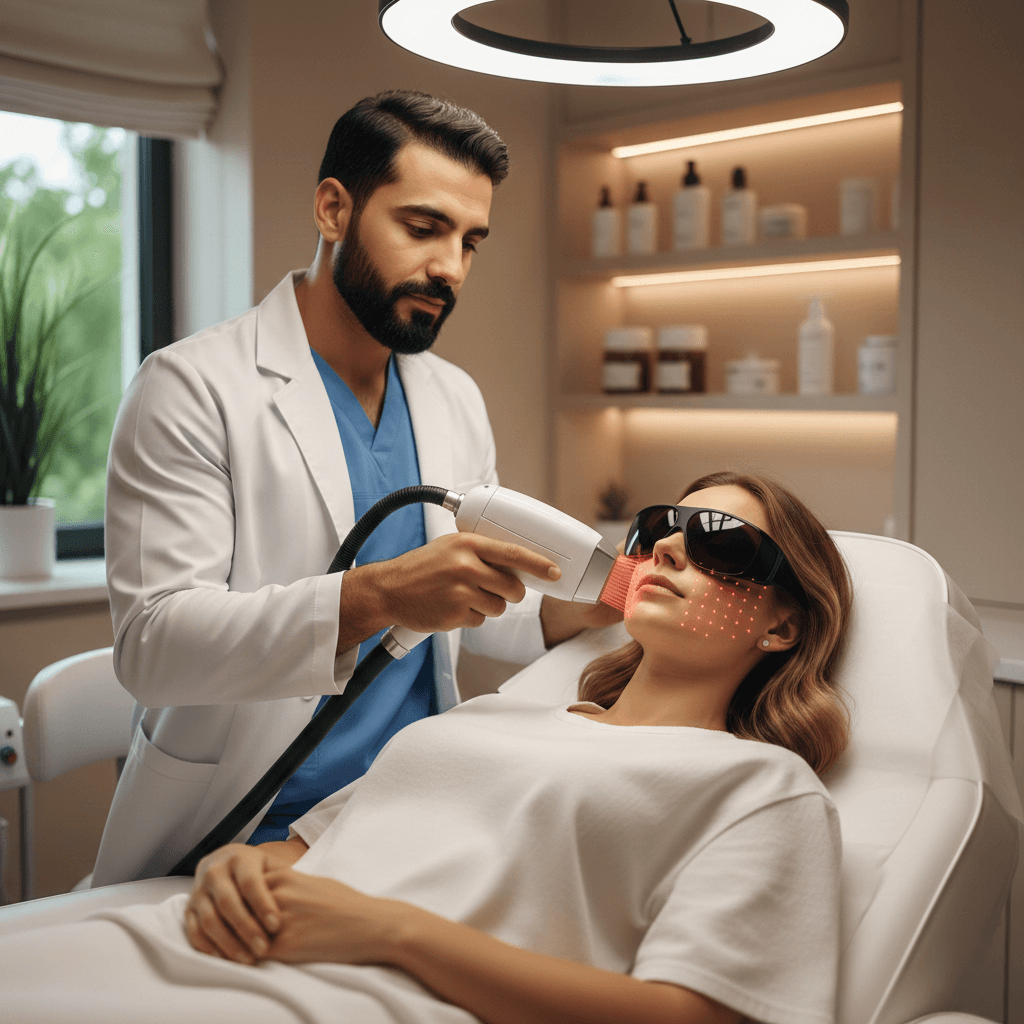
#What Is Fractional Resurfacing?
Fractional resurfacing is a category of laser skin treatments that has transformed the field of skin rejuvenation. The fundamental innovation of fractional technology is treating the skin in a precise pattern of thousands of microscopic columns, called microthermal zones, while leaving the surrounding skin intact. This fractional approach dramatically reduces healing time and risk compared to traditional full-field resurfacing, while still delivering remarkable results for acne scarring, wrinkles, sun damage, uneven texture, and pigmentation.
Think of it this way: rather than resurfacing 100% of the skin surface (as traditional lasers did), fractional technology treats typically 5% to 40% of the surface in a single session, depending on device settings and treatment goals. This leaves bridges of healthy, untreated skin between the treatment zones. These intact skin bridges serve as a reservoir of healthy cells that accelerate healing and dramatically reduce the risk of complications like scarring and prolonged redness.
There are two main categories of fractional resurfacing:
Ablative fractional resurfacing uses lasers that vaporise (ablate) tiny columns of skin tissue, including the surface epidermis. The two primary ablative fractional lasers are:
- Fractional CO2 laser (carbon dioxide, 10,600nm wavelength), powerful and effective for deep concerns like severe acne scarring and deep wrinkles. Considered the gold standard for ablative fractional resurfacing. Particularly for significant acne scarring and deep photoageing.
- Fractional erbium laser (Er:YAG, 2,940nm wavelength), more precisely absorbed by water in the skin, creating less collateral thermal damage and offering faster healing with less prolonged redness. The trade-off is that Er:YAG also produces less collagen tightening and remodelling than CO2 because of that reduced thermal effect, so it is often preferred for milder concerns or patients prioritising shorter recovery.
Non-ablative fractional resurfacing uses lasers that heat the dermal tissue beneath the skin surface without vaporising the outer layer. The epidermis remains intact, resulting in significantly less downtime. Common non-ablative fractional devices include the 1550nm erbium glass laser, the 1927nm thulium laser (often combined as Fraxel Dual), and other thulium fibre lasers.
In Ireland, fractional resurfacing is offered at specialist clinics and register-verified aesthetic practices in Dublin, Cork, Galway, Limerick, and other cities. The treatment has become one of the most sought-after options for patients with significant skin concerns who want results that skincare products and gentler treatments simply cannot achieve.
#How Does Fractional Resurfacing Work?
The science behind fractional resurfacing is based on the principle of controlled wound healing. By creating precise, microscopic injuries in the skin. The treatment harnesses the body's natural repair mechanisms to produce new, healthy, remodelled tissue.
Ablative fractional mechanism:
Ablative fractional lasers emit concentrated beams of light that are absorbed by water molecules in the skin. The energy is so intense that it instantly vaporises the water and the tissue containing it, creating a column of removed skin called a microthermal zone (MTZ). Each MTZ is typically 100 to 300 micrometres in diameter and can extend from the skin surface to depths of 200 to 1,500 micrometres or more, depending on the laser settings.
The CO2 laser creates deeper MTZs with more surrounding thermal coagulation (heat damage to adjacent tissue). This thermal effect actually contributes to collagen tightening, the heat causes existing collagen fibres to contract and denature, triggering the production of new, organised collagen. The erbium laser creates shallower MTZs with less thermal coagulation, resulting in more precise ablation and faster healing but less collagen tightening.
After each MTZ is created, the body rapidly initiates a wound healing cascade:
- Inflammation phase (days 1–3): Blood flow increases, immune cells migrate to the area, and damaged tissue is cleared.
- Proliferation phase (days 3–14): New epithelial cells migrate from the surrounding untreated skin to fill the MTZs. New collagen is synthesised by activated fibroblasts.
- Remodelling phase (weeks to months): As the collagen matures, the initial type III collagen remodels into more durable type I collagen, consistent with normal skin healing processes. The tissue continues to improve in structure and quality for 3 to 6 months or longer after treatment.
Non-ablative fractional mechanism:
Non-ablative fractional lasers create columns of thermal injury in the dermis without disrupting the overlying epidermis. The surface of the skin remains intact, which is why recovery is significantly faster. The dermal heating stimulates fibroblast activity and collagen remodelling, but because the process is less aggressive, multiple sessions are typically needed to achieve results comparable to a single ablative treatment.
Treatment delivery:
Modern fractional laser systems deliver the treatment through a handpiece that is moved across the skin in a stamping or rolling pattern. Computer-controlled scanning systems ensure precise, even distribution of MTZs. The practitioner can adjust several parameters to customise the treatment:
- Energy/power: Determines the depth of each MTZ
- Density: Controls the percentage of skin surface treated (spacing between MTZs)
- Pattern: The arrangement of MTZs across the treatment area
- Number of passes: How many times the laser passes over the same area
These variables allow the treatment to be tailored from gentle (low energy, low density) to aggressive (high energy, high density), depending on the patient's concerns, skin type, and tolerance for downtime. Aggressive settings can deliver better single-session results but come with more downtime and higher risk of complications; gentle settings are safer and have less downtime but may require more sessions to reach the same endpoint. Your practitioner will help you weigh this trade-off based on your goals and availability for recovery.
#Common Treatment Areas
Fractional resurfacing can treat a wide range of skin concerns across multiple body areas. Its versatility is one of the treatment's key advantages.
Skin concerns treated:
- Acne scarring: Fractional CO2 laser is considered the gold standard treatment for moderate to severe acne scars. It is effective for ice pick scars, boxcar scars, rolling scars, and post-acne textural irregularities. Studies consistently show 50% to 70% improvement in acne scarring with ablative fractional treatment.
- Wrinkles and fine lines: Both ablative and non-ablative fractional treatments effectively reduce fine lines and moderate wrinkles. Particularly around the eyes (crow's feet), mouth (perioral lines), and forehead.
- Sun damage: Fractional resurfacing improves the effects of chronic sun damage, including rough texture, dyspigmentation, and photoaged skin. The 1927nm wavelength in particular targets superficial pigmentation effectively.
- Pigmentation and age spots: Sun-induced lentigines (age spots), solar keratoses, and general dyspigmentation respond well to fractional treatment. Note: hormonal pigmentation (melasma) requires a careful, cautious approach.
- Enlarged pores: The collagen remodelling stimulated by fractional treatment can tighten pore openings and improve skin texture.
- Skin texture: Overall skin texture, roughness, and irregularities are significantly improved.
- Surgical and traumatic scars: Fractional resurfacing can improve the appearance of scars from surgery, injury, or burns.
- Stretch marks: While not a primary indication, fractional treatment can improve the texture and appearance of stretch marks.
- Skin laxity: The thermal collagen tightening effect of ablative fractional treatment provides a mild to moderate skin tightening benefit. Particularly useful for early skin laxity.
Treatment areas on the face:
- Full face
- Periorbital area (around the eyes), with protective eye shields
- Perioral area (around the mouth)
- Forehead
- Cheeks
- Nose
- Chin
Treatment areas on the body:
- Neck
- Decolletage (chest), a common area for sun damage treatment
- Hands
- Arms
- Abdomen (for stretch marks or loose skin)
- Thighs
Area-specific considerations:
The neck and decolletage require more conservative settings than the face, as the skin in these areas heals more slowly and is more prone to complications. The periorbital area requires metal eye shields and careful technique. Body areas generally heal more slowly than the face due to fewer pilosebaceous units (hair follicles and oil glands), which serve as reservoirs of new skin cells during healing.
#During the Procedure
Understanding what happens during treatment helps reduce anxiety and set expectations.
Pre-treatment preparation (30–60 minutes before):
A thick layer of topical anaesthetic cream (typically a compounded lidocaine/prilocaine mixture) is applied to the treatment area and covered with cling film to enhance penetration. For ablative treatments. Some practitioners may also use nerve blocks (local anaesthetic injections) for additional pain control. Particularly around the lips and eyes. Cooling devices and cold air blowers are often used during treatment to improve comfort.
Antiviral prophylaxis. For ablative fractional treatments, prophylactic antiviral medication is often prescribed routinely, regardless of cold sore history, because thermal injury can reactivate latent herpes simplex virus and cause serious infection in broken skin. For non-ablative treatments, antivirals are typically prescribed only in patients with a history of cold sores.
The treatment (20–45 minutes for the laser phase):
-
Eye protection: Metal eye shields are placed on the eyes (if treating the face) and everyone in the room wears laser-specific safety glasses.
-
Laser application: The practitioner moves the handpiece systematically across the treatment area. For scanning devices, the handpiece is held in position while the computer-controlled scanner delivers the pattern of laser spots. For manual devices. The practitioner stamps or glides the handpiece across the skin.
-
Sensation: Ablative treatment feels like a series of hot pinpricks or a burning, stinging sensation. The topical anaesthesia significantly reduces pain, but most patients still feel some discomfort. Particularly around the perioral area and forehead. Non-ablative treatment produces a hot, prickling sensation that most patients find tolerable.
-
Multiple passes: Depending on the treatment plan, your practitioner may make 1 to 3 passes over the treatment area. Higher numbers of passes at lower settings can achieve results comparable to fewer passes at higher settings, with potentially more even results.
-
Immediate appearance: After ablative treatment, the skin appears white (from tissue vaporisation), then rapidly becomes red and begins to weep a serum-like fluid. This is a normal inflammatory response. After non-ablative treatment, the skin appears red and mildly swollen, similar to sunburn.
Post-treatment application:
After the laser treatment, a soothing ointment, healing balm, or specialised post-laser product is applied to the skin. For ablative treatments, an occlusive ointment (such as petroleum jelly or a prescribed healing balm) is typically applied to keep the skin moist during the initial healing phase. Some practitioners use a bio-cellulose mask or cooling sheet for immediate comfort.
Total appointment time:
Including numbing, treatment, and post-care, expect the full appointment to take 60 to 90 minutes for ablative treatment and 45 to 60 minutes for non-ablative treatment.
#How Much Does Fractional Resurfacing Cost in Ireland?
Fractional resurfacing is a significant investment, both financially and in recovery time. Typical pricing in Ireland:
- Non-ablative fractional treatments (e.g., 1550nm / 1927nm thulium): €300 to €500 per session. Most patients need 3 to 6 sessions for a full course (€900 to €3,000 total).
- Ablative fractional erbium (Er:YAG): €500 to €900 per session, typically 1 to 2 sessions.
- Ablative fractional CO2 laser: €800 to €1,500+ per session for a full face, typically 1 to 3 sessions depending on severity.
- Targeted small-area treatment (around the eyes or mouth): €300 to €600 per session.
- Full face and neck combination: €1,000 to €2,000+ per session.
Prices vary with the specific device, practitioner experience, and location. Some programmes include pre-treatment skincare products, antiviral medications, and follow-up appointments; others charge these separately. Ask what is included in the quoted price.
#Practical Downtime
Be realistic about time away from work and social life when planning this treatment:
- Non-ablative fractional: 1 to 3 days of visible redness and mild swelling; most people return to work the next day with makeup.
- Ablative fractional (Er:YAG or light CO2): 5 to 10 days of visible healing with peeling and pinkness; most patients take around a week off social plans.
- Ablative fractional CO2 (aggressive settings): 7 to 14 days of active recovery with oozing, crusting, and peeling, followed by pink undertones that can persist for weeks to months. Most patients take 1 to 2 weeks off work or social activities.
Plan for strict sun avoidance and broad-spectrum SPF 50+ daily for at least 4 weeks after any fractional treatment, with ongoing diligent sun protection essential to protect results and minimise pigmentation complications.
#Results Timeline
Fractional resurfacing results develop over weeks to months as the skin heals and remodels. Understanding this timeline helps manage expectations.
Ablative fractional results:
- Week 1: Healing phase, skin is pink, peeling, and recovering. No aesthetic improvement visible yet.
- Weeks 2–4: Once initial healing is complete, early improvements in skin texture and tone become apparent. Pigmented lesions may significantly fade or clear, though some types (particularly melasma) can recur over time and may require ongoing management.
- Months 1–3: Collagen remodelling is actively occurring. Skin continues to improve in firmness, texture, and tone. Acne scars show progressive improvement. Residual redness fades.
- Months 3–6: Peak results develop as collagen maturation occurs. This is when the full benefit of the treatment is visible, smoother texture, improved scarring, reduced wrinkles, more even pigmentation.
- Months 6–36: Results are long-lasting, as the new collagen and remodelled skin are permanent improvements. However, normal ageing and ongoing sun damage will gradually affect the skin over time. Maintenance treatments and diligent sun protection help sustain results.
Non-ablative fractional results:
Results are more subtle per session and develop cumulatively:
- After each session: Mild improvement in skin texture and radiance
- After 3–4 sessions: Noticeable improvement in fine lines, texture, and mild pigmentation
- After full course (4–6 sessions): Significant cumulative improvement in overall skin quality, pore size, texture, fine wrinkles, and pigmentation
- Peak results: 2 to 3 months after the final session
What to realistically expect:
- Acne scarring: 50% to 70% improvement with ablative fractional treatment (1 to 3 sessions); 30% to 50% improvement with non-ablative (4 to 6 sessions)
- Fine lines and wrinkles: Significant softening of fine lines; moderate improvement in deeper wrinkles
- Sun damage and pigmentation: Significant improvement in sunspots and dyspigmentation (more dramatic with ablative, more gradual with non-ablative)
- Skin texture: Substantial improvement in smoothness, pore size, and overall skin quality
- Skin tightening: Mild to moderate tightening effect. Particularly with ablative CO2
#Choosing a Practitioner in Ireland
Fractional resurfacing is an advanced medical procedure with significant variables that affect safety and outcomes. Choosing the right practitioner is paramount.
Qualifications:
- Doctors registered with the Medical Council of Ireland
- Dentists registered with the Dental Council of Ireland
- Nurses registered with NMBI (Nursing and Midwifery Board of Ireland)
Ireland currently has limited regulation of laser treatments specifically, which means qualifications and experience vary widely. For ablative fractional resurfacing, a doctor with extensive laser experience, ideally a dermatologist or plastic surgeon, is strongly recommended. Your due diligence is essential.
What to look for:
- Device-specific training: Ask which device the clinic uses and what training the operator has on that specific system. Different fractional lasers have different characteristics and require specific knowledge.
- Skin type assessment experience: A practitioner who carefully assesses your Fitzpatrick skin type and adjusts treatment parameters accordingly is demonstrating good clinical judgement.
- Before and after portfolio: Request to see photographs of the practitioner's own patients, ideally showing results for concerns similar to yours.
- Comprehensive consultation: A thorough pre-treatment assessment that includes skin type evaluation, medical history, discussion of expectations, and clear explanation of the recovery process.
- Emergency protocols: The clinic should have protocols for managing complications, including burns, infections, and pigmentation changes.
- Follow-up care: A good clinic provides detailed aftercare instructions, aftercare products, and scheduled follow-up appointments.
- Honest assessment: The best practitioners will tell you if your concern would be better treated with a different modality or if your skin type makes fractional resurfacing inadvisable.
Comparing clinics:
Use SafeSkin to find a verified clinic offering fractional resurfacing in Ireland. You can compare clinics by location, qualifications, and treatment offerings to find the right practitioner for your needs. Consider visiting two or three clinics for consultations before committing to treatment. This allows you to compare approaches and choose the practitioner you feel most confident with.