
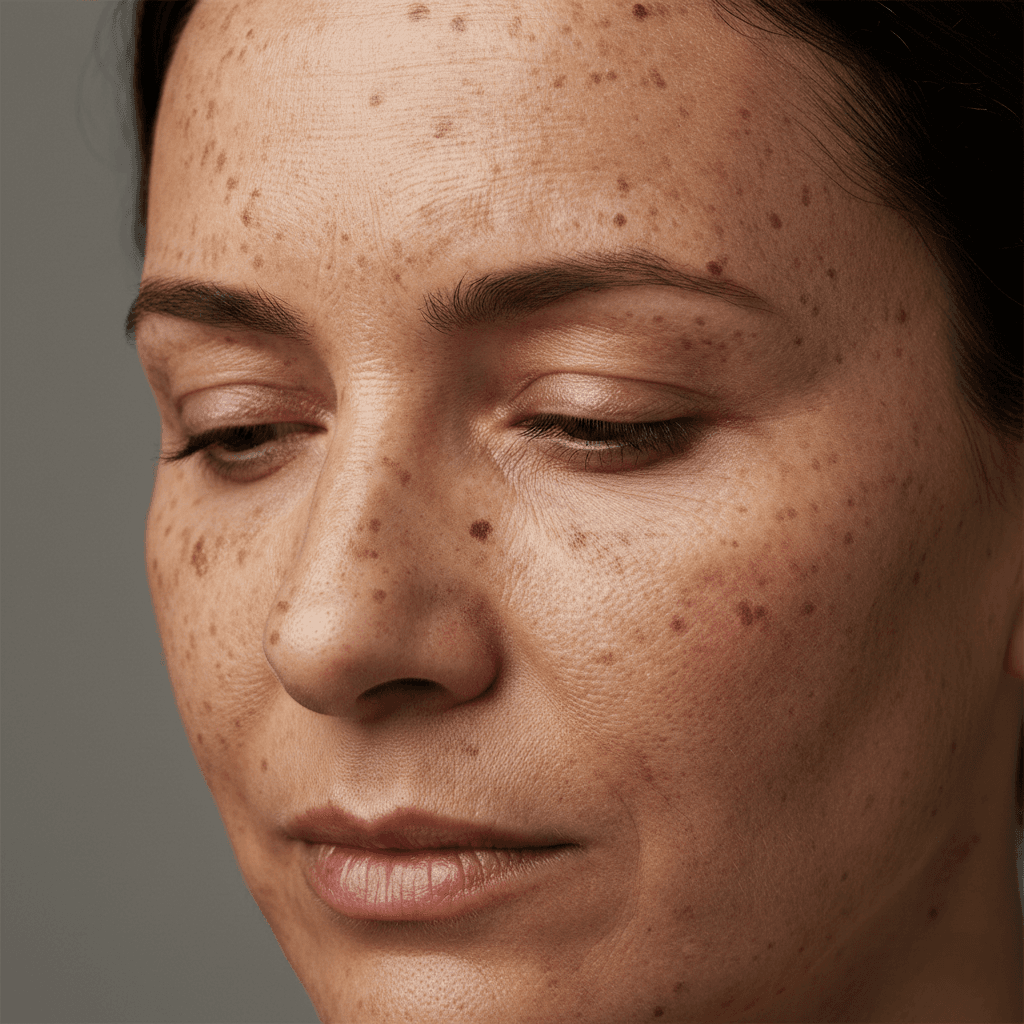
Understanding Pigmentation / Sun Damage
Pigmentation disorders are among the most common skin concerns presenting at aesthetic clinics across Ireland. They encompass a broad range of conditions characterised by areas of skin that appear darker, lighter, or differently coloured compared to the surrounding skin. Sun damage — more formally known as photodamage — is the primary external cause of acquired pigmentation in Irish skin types.
The colour of our skin is determined by melanin, a pigment produced by specialised cells called melanocytes in the basal layer of the epidermis. Melanin serves a protective function, absorbing UV radiation to shield the deeper skin layers from DNA damage. When the skin is exposed to UV light, melanocytes ramp up melanin production — this is the tanning response. However, over time, repeated or excessive UV exposure can cause melanocytes to become dysregulated, producing melanin unevenly or excessively in certain areas. This leads to the dark spots, patches, and uneven tone that characterise pigmentation disorders.
In Ireland, pigmentation concerns present a particularly interesting clinical picture. The predominantly fair, Celtic skin types (Fitzpatrick types I and II) that are common among the Irish population are inherently more vulnerable to UV damage. While darker skin types produce more melanin and have a degree of built-in sun protection, fair-skinned individuals burn more easily and accumulate photodamage more rapidly. Paradoxically, pigmentation can be both more easily caused and more visibly noticeable on lighter skin.
Despite Ireland's northerly latitude and reputation for grey skies, UV exposure is a genuine concern. The Environmental Protection Agency (EPA) Ireland monitors UV levels and consistently reports that UV Index values during the Irish summer can reach levels comparable to southern European countries on clear days. Even on overcast days, up to 80 per cent of UV radiation reaches the ground. This cumulative exposure over decades is the primary driver of solar lentigines (sunspots), diffuse photodamage, and contributions to more complex pigmentation conditions like melasma.
It is important to distinguish cosmetic pigmentation from potentially dangerous pigmented skin lesions. Any new, changing, or irregular pigmented mark should be assessed by a GP or dermatologist before cosmetic treatment is considered. The Irish Cancer Society provides excellent resources on the ABCDE checklist for skin checks.
What Causes Pigmentation / Sun Damage?
Pigmentation disorders arise from different mechanisms, and understanding the underlying cause is essential for selecting the most effective treatment.
Ultraviolet (UV) radiation is the most significant external cause of acquired pigmentation in Ireland. Both UVA and UVB rays stimulate melanin production, but their effects differ. UVB causes sunburn and stimulates immediate tanning, while UVA penetrates deeper into the dermis, causes photoageing, and contributes to long-term melanocyte dysfunction. UVA is present at relatively consistent levels throughout the year and penetrates cloud cover and glass. Years of cumulative UV exposure lead to solar lentigines (commonly called age spots or liver spots), diffuse freckling, and the mottled, uneven skin tone characteristic of photodamage.
Hormonal influences are the primary driver of melasma, a condition characterised by symmetrical patches of brown or grey-brown pigmentation on the face. Oestrogen and progesterone stimulate melanocyte activity, which is why melasma commonly appears during pregnancy (when it is known as chloasma or the "mask of pregnancy"), while using oral contraceptives, or during hormone replacement therapy (HRT). Up to 50 per cent of women experience some degree of melasma during pregnancy. UV exposure dramatically worsens hormonally-driven pigmentation.
Post-inflammatory hyperpigmentation (PIH) occurs when the skin produces excess melanin in response to injury or inflammation. This is particularly common following acne breakouts, eczema flares, burns, cuts, or even overly aggressive skincare treatments. The darker marks left after an acne spot heals are a classic example of PIH. People with darker skin tones (Fitzpatrick types III to VI) are more susceptible, but it affects all skin types.
Genetics influence your baseline melanin production, the number and activity level of your melanocytes, and your predisposition to conditions like freckling and melasma. A family history of pigmentation disorders increases your likelihood of developing them.
Medications can cause or worsen pigmentation. Certain antibiotics (tetracyclines), anti-malarial drugs, non-steroidal anti-inflammatory drugs, and some chemotherapy agents can trigger photosensitivity or direct pigment changes. Always inform your aesthetic practitioner of all medications you are taking.
Skin injuries and treatments can paradoxically cause pigmentation. Laser treatments, chemical peels, and even aggressive exfoliation can trigger PIH if performed incorrectly, at inappropriate settings, or on unsuitable skin types. This is why it is crucial to choose an experienced, qualified practitioner who will properly assess your skin before treatment.
Types and Severity Levels
Accurate identification of the pigmentation type is the foundation of effective treatment. Different types respond to different approaches, and some can be worsened by treatments that work well for other types.
Solar lentigines (sunspots/age spots) are flat, well-defined brown spots that appear on sun-exposed areas — typically the face, hands, chest, and shoulders. They result from cumulative UV exposure and are extremely common in Irish adults over 40. They respond well to most pigmentation treatments.
Freckles (ephelides) are small, flat brown spots that darken with sun exposure and fade in winter. They are genetically determined and very common in Irish people with red or fair hair. While cosmetically harmless, their prominence can be reduced with treatment.
Melasma presents as larger, irregularly shaped patches of brown or grey-brown pigmentation, typically symmetrically distributed on the cheeks, forehead, nose bridge, chin, and upper lip. It has a characteristic "muddy" or diffuse appearance. Melasma is the most challenging pigmentation condition to treat and requires a specialised, gentle approach.
Post-inflammatory hyperpigmentation (PIH) appears as dark marks at the sites of previous skin inflammation — acne spots, insect bites, scratches, or rashes. The marks can range from pink to red to brown to dark brown, depending on skin type and the depth of pigment deposition.
Diffuse photodamage presents as a general unevenness and mottling of skin tone, often with a mix of sunspots, broken capillaries, rough texture, and a dull, uneven appearance. It reflects years of cumulative sun exposure and is very common in Irish adults.
Severity levels:
- Mild — A few scattered sunspots or freckles, or mild post-inflammatory marks. Skin tone is slightly uneven but generally uniform.
- Moderate — Multiple sunspots, noticeable uneven tone, early melasma, or prominent PIH. The irregularity is visible in normal lighting.
- Severe — Widespread sunspots, dense freckling, established melasma, or significant diffuse photodamage. The unevenness significantly affects the overall appearance of the skin.
Treatment Options Available in Ireland
Irish aesthetic clinics offer a comprehensive range of treatments for pigmentation and sun damage. The appropriate treatment depends on the type, depth, and cause of the pigmentation. All treatments should be performed by practitioners registered with the Medical Council of Ireland, the Dental Council, or the Nursing and Midwifery Board of Ireland (NMBI).
IPL (Intense Pulsed Light) is one of the most popular and effective treatments for sun damage-related pigmentation in Ireland. It delivers broad-spectrum light that is selectively absorbed by melanin, breaking down pigmented cells without damaging the surrounding skin. IPL is particularly effective for solar lentigines, diffuse photodamage, and general skin tone improvement. A course of 3 to 6 sessions is typically recommended. Learn more about IPL treatments.
Chemical peels accelerate the removal of pigmented surface skin cells, revealing fresher, more evenly toned skin beneath. Different peel depths and formulations suit different pigmentation types. Superficial peels (glycolic acid, lactic acid) are excellent for mild pigmentation and dull skin. Medium-depth peels (TCA) can address more stubborn pigmentation. Learn more about chemical peels.
Laser skin treatments offer precise targeting of pigmented lesions. Q-switched lasers and picosecond lasers can break down melanin deposits with high specificity. Different wavelengths target different pigment depths. Laser treatments are particularly effective for well-defined sunspots and certain birthmarks. However, they must be used cautiously on melasma, as the energy can trigger a rebound worsening. Learn more about laser treatments.
Medical microneedling creates controlled micro-channels in the skin, allowing enhanced penetration of brightening serums and stimulating the skin's renewal process. It can improve pigmentation by accelerating the turnover of pigmented cells and improving overall skin quality. When combined with vitamin C or tranexamic acid serums, it is particularly effective. Learn more about microneedling.
Medical-grade skincare is a cornerstone of pigmentation treatment and often the first line of defence. Key active ingredients include:
- Hydroquinone — the gold standard for melanin suppression (prescription-strength in Ireland)
- Vitamin C (L-ascorbic acid) — an antioxidant that inhibits melanin production and brightens skin
- Retinoids — increase cell turnover and help disperse pigment
- Azelaic acid — reduces melanin production and has anti-inflammatory properties
- Niacinamide — inhibits melanin transfer to skin cells
- Tranexamic acid — increasingly used for melasma management
- Alpha arbutin and kojic acid — natural melanin inhibitors
Learn more about medical-grade skincare.
Skin boosters and Profhilo can improve overall skin quality and hydration, creating a more even, luminous skin tone as a complement to targeted pigmentation treatments. Learn more about Profhilo.