
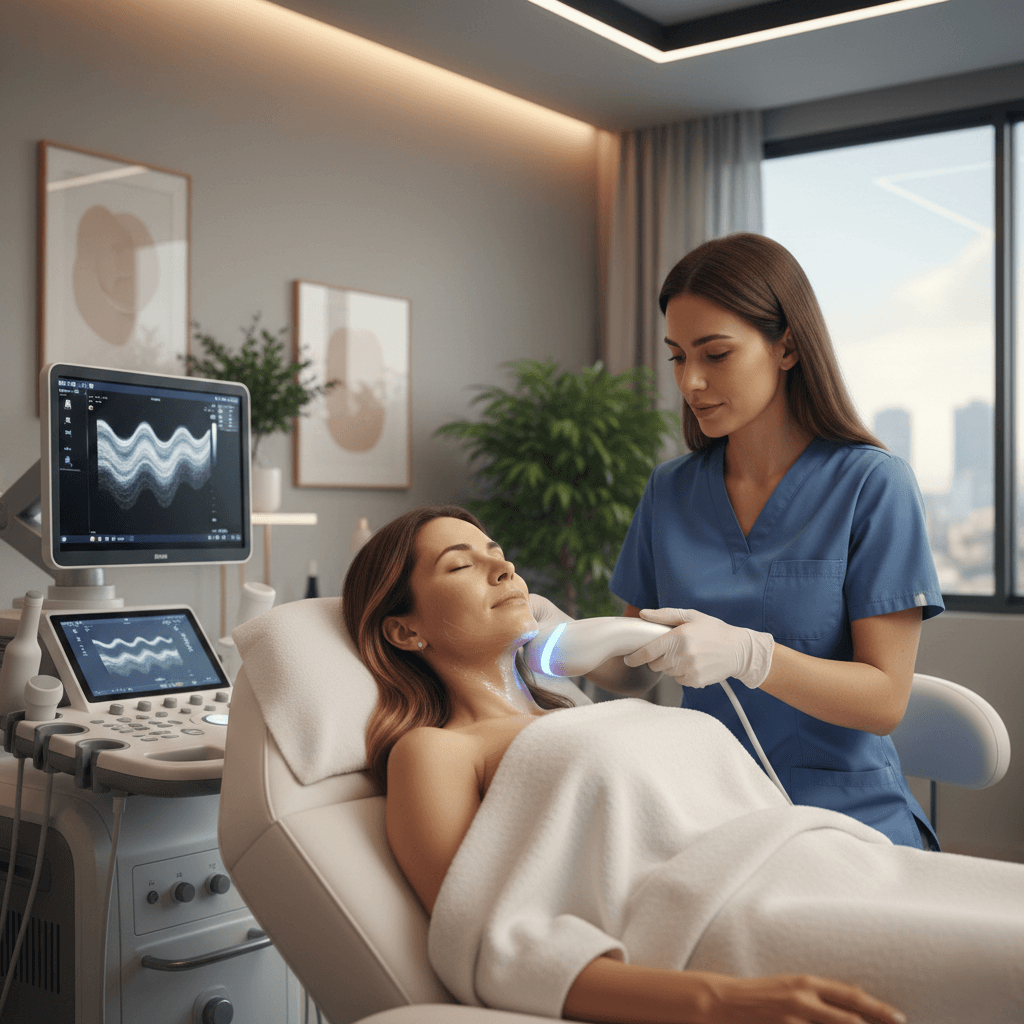
What Is HIFU?
HIFU, High-Intensity Focused Ultrasound, is a non-invasive skin tightening and lifting treatment that uses focused ultrasound energy to stimulate collagen production deep within the skin and the underlying tissue layers. It is sometimes referred to as a "non-surgical facelift," though it is important to understand that it does not replicate the results of surgery. Typical HIFU results include subtle firming and mild lifting of around 1 to 3mm, meaningful but significantly less dramatic than a surgical facelift. What it does offer is a genuinely non-invasive alternative for patients experiencing mild to moderate skin laxity who want a lifted, firmer, more defined appearance without going under the knife.
In Ireland, HIFU has become one of the most sought-after non-surgical lifting treatments. Particularly among patients aged 35 to 60 who are beginning to notice sagging along the jawline, loss of definition in the chin and neck area, or a drooping brow. At its deepest 4.5mm setting, HIFU targets the SMAS layer, the same structural layer addressed in a surgical facelift, though the mechanism (thermal collagen stimulation rather than surgical repositioning) is fundamentally different, and facial anatomy varies such that 4.5mm may not reach the SMAS uniformly in all patients or regions.
HIFU was originally developed for medical applications including the treatment of tumours, and its cosmetic adaptation received US FDA clearance for non-invasive brow lifting in 2009, and for the decolletage and neck in subsequent years. HIFU devices used in Ireland are CE-marked for use in Europe. The most well-known HIFU platform is Ultherapy (by Merz Aesthetics), though several other reputable devices are now available in Irish clinics, including Ultraformer III, Doublo Gold, and Ultracel Q+.
Most patients have an initial treatment, with maintenance sessions typically every 12 to 18 months as results gradually fade. Some initial subtle tightening may be noticed in the days following treatment from collagen contraction, with the full results developing gradually over 2 to 6 months as new collagen is laid down.
Individual response varies considerably. This is one of the most important things to understand about HIFU. Some patients see significant improvement while others experience more modest results. This variability is not fully understood and depends on factors including skin quality, age, device used, operator technique, and individual biological response. It is worth going into treatment with realistic, flexible expectations.
How Does HIFU Work?
HIFU technology works by delivering highly focused ultrasound energy to precise depths beneath the skin's surface. The principle is similar to focusing sunlight through a magnifying glass, the energy is concentrated at a specific point to create a thermal effect without damaging the tissue above or below that point.
Here is the step-by-step process of a HIFU treatment:
-
Consultation and assessment, Your practitioner evaluates your facial anatomy, skin quality, and degree of laxity. They determine which areas to treat and at what tissue depths. Photographs are taken for your records.
-
Preparation, The treatment area is cleansed and an ultrasound gel is applied to the skin. This gel helps the ultrasound energy transmit efficiently. Some practitioners apply topical numbing cream or offer oral pain medication. Particularly for sensitive areas.
-
Imaging, Using the device's built-in ultrasound imaging. The practitioner can visualise the tissue layers beneath the skin in real time. This allows them to confirm the depth and target their treatment precisely, a significant safety advantage over treatments that work "blind."
-
Energy delivery, The practitioner places the HIFU handpiece against the skin and delivers lines of focused ultrasound energy. Each pulse creates a tiny thermal coagulation point (TCP) at a precise depth, typically at 4.5mm (targeting the SMAS layer in most facial regions), 3.0mm (the deep dermis), and 1.5mm (the superficial dermis). Temperatures at the focal point typically reach around 65 to 75 degrees Celsius, sufficient to trigger collagen denaturation and contraction.
-
Systematic treatment, The practitioner works systematically across the treatment area, placing hundreds of these thermal points in a precise grid pattern. A full face and neck treatment typically involves several hundred lines or shots of ultrasound energy, with the exact count depending on the device and protocol.
-
Eye safety for brow lift applications, When HIFU is used for brow lifting, the energy is carefully placed away from the orbit to protect the eye, using specific depths and patterns designed to avoid ocular structures. Modern protocols explicitly avoid the orbital region.
-
Completion, The gel is removed and aftercare instructions are provided. No bandages or dressings are required.
The focused nature of the ultrasound means that the skin's surface remains intact throughout the procedure. The body's natural wound-healing response then kicks in, producing new collagen and elastin over the following months to replace the damaged proteins, resulting in tighter, firmer, and more lifted skin.