Laser skin treatments are among the most powerful tools in aesthetic medicine. They can resurface sun-damaged skin, soften lines and wrinkles, fade pigmentation, improve acne scarring, and tighten lax skin.
However, as they are also among the most varied and most misunderstood treatments, it is important to know what's what.
Simply put, "laser" is not one single thing. It is a broad family of different technologies, each suited to different concerns, with very different levels of intensity, downtime, and cost.
This guide explains the main types of laser skin treatment available in Ireland, what each one does, what they cost, and crucially, why one factor (your practitioner's experience) matters more than almost any other.
What laser skin treatments actually do
A laser delivers a focused beam of light at a specific wavelength. Different wavelengths are absorbed by different targets in the skin: water, pigment, or the blood in tiny vessels. By choosing the right laser and settings, a practitioner can target a specific concern while limiting the effect on surrounding tissue.
Broadly, laser skin treatments fall into two categories, and understanding the difference is the key to understanding the whole field.
Ablative lasers remove the outer layers of skin. They work by heating and vaporising the surface, which triggers an intensive healing and collagen-rebuilding response. They produce the most dramatic results, but they also involve the most downtime, because the skin needs time to heal afterwards.
Non-ablative lasers leave the surface of the skin largely intact and instead deliver heat into the deeper layers to stimulate collagen production. They are gentler, with much less downtime, but the results are more gradual and usually require a course of several sessions.
Many modern treatments are also fractional, meaning the laser treats only a fraction of the skin surface at a time, leaving small areas of untreated skin between the treated columns. This speeds up healing significantly while still stimulating a strong rejuvenation response, and it is why fractional lasers have become so popular.
The main types of laser treatment in Ireland
Fractional CO2 laser resurfacing
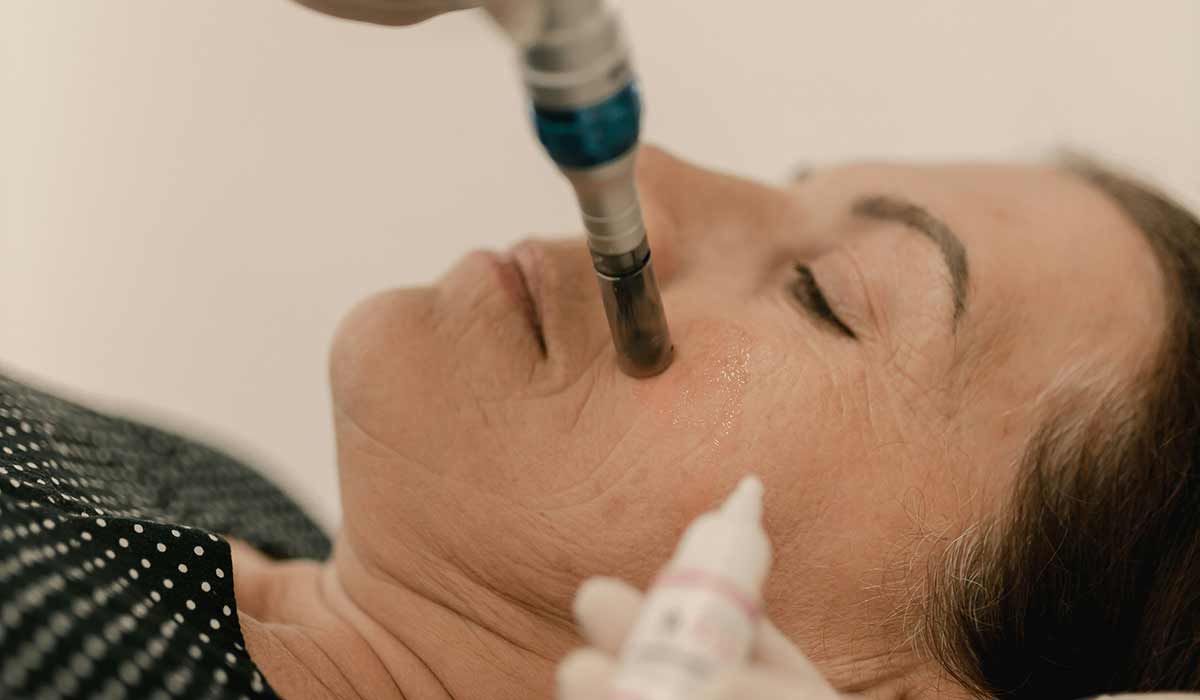
Fractional CO2 laser is widely considered the gold standard for ablative skin resurfacing. It uses a carbon dioxide laser to create controlled micro-injuries in the skin, removing damaged surface layers and stimulating significant collagen renewal in the deeper layers.
CO2 resurfacing is one of the most effective treatments available for sun damage, fine lines and wrinkles, uneven texture, enlarged pores, and acne scarring. Because it is intensive, it typically involves several days of social downtime, with redness, swelling, and peeling as the skin heals, but it can produce dramatic improvement, sometimes in a single treatment.
In Ireland, full-face CO2 laser resurfacing typically starts from around €1,500, while smaller areas such as around the eyes, the upper lip, or individual scars often start from around €500 per treatment. Package discounts are sometimes available. Because of its intensity, CO2 resurfacing should only be carried out by a medical practitioner.
Erbium and other ablative lasers
Erbium lasers are another ablative option, often used for fine lines, sun damage, and more superficial concerns.
They can be gentler than CO2 in some applications, with slightly less downtime. The choice between them depends on your skin and your specific concerns.
A qualified practitioner will advise which is more appropriate.
Non-ablative and fractional non-ablative lasers
Non-ablative lasers, including various fractional non-ablative systems, improve skin tone, texture, fine lines, and mild pigmentation with much less downtime than ablative treatments.
The trade-off is that results are more gradual, and a course of several sessions is usually needed.
These treatments suit people who want meaningful improvement without the recovery time of CO2 resurfacing.
Pigmentation and vascular lasers
Some lasers are designed specifically to target pigment or blood vessels rather than to resurface the skin.
Pigmentation lasers, such as Q-switched and picosecond lasers, target melanin to break down sun spots, age spots, and other pigmentation.
Vascular lasers target the blood in small vessels, making them useful for redness, broken vessels, and conditions like rosacea.
In Ireland, laser pigmentation removal typically costs in the region of €150 to €400 per treatment, depending on the size and depth of the area being treated. A course is often needed for the best result.
For more on pigmentation specifically, see our guide to pigmentation and sun damage.
A note on IPL
IPL (Intense Pulsed Light) is often grouped with laser treatments, but technically it is not a laser.
IPL uses broad-spectrum light rather than a single focused wavelength, which makes it versatile for diffuse redness and superficial pigmentation, though generally less precise and less powerful than a true laser for any single concern.
It is a useful and popular treatment in its own right, and a good practitioner will advise whether IPL or a laser is more appropriate for your skin.
What laser treatments cost in Ireland: a summary
Laser pricing varies widely depending on the technology, the area treated, the number of sessions required, and the clinic.
As a general guide based on current Irish pricing: full-face CO2 laser resurfacing typically starts from around €1,500; smaller areas with CO2 from around €500; and laser pigmentation treatment from around €150 to €400 per session.
Non-ablative and fractional treatments vary considerably and are usually sold as a course.
Because many laser treatments require more than one session, it is sensible to ask about the total likely cost of a full course rather than focusing on a single-session price.
You can use our cost calculator to estimate the cost of treatment.
Downtime, recovery, and what to expect
Downtime is one of the most important things to understand before choosing a laser treatment, because it varies enormously.
Ablative treatments like CO2 resurfacing involve meaningful recovery: redness, swelling, and peeling for several days to a week or more, depending on the depth of treatment. This is a genuine medical procedure, and you need to plan for the recovery period.
Non-ablative and pigmentation treatments generally involve much less downtime, often just some redness for a day or two, though specific aftercare still applies.
Sun protection is essential after any laser treatment. Freshly treated skin is especially vulnerable to UV damage and pigmentation, so daily broad-spectrum SPF and sun avoidance during the healing period are non-negotiable.
Your practitioner will give you specific aftercare instructions, and following them closely has a real effect on your result and your safety.
Safety, skin tone, and why the practitioner matters most
This is the most important section of this guide. Laser treatments are powerful, and in the wrong hands, they can cause real harm: burns, scarring, and pigmentation changes that can be long-lasting.
Skin tone is a particularly important factor. Some lasers carry a higher risk of complications, including burns and post-inflammatory pigmentation, on darker skin tones. An experienced practitioner will choose the right laser and settings for your specific skin type, or will advise against laser treatment altogether if it is not suitable for you. A practitioner who uses the same laser and settings for everyone, regardless of skin tone, is a serious concern.
The single most important determinant of a good laser outcome is the experience and qualification of the person performing the treatment. The more intensive treatments, such as CO2 resurfacing, should be carried out by a medical practitioner.
For all laser treatments, you want someone properly trained, experienced with your skin type, and working in a proper clinical setting with appropriate equipment and safety protocols.
We always recommend choosing a practitioner registered on the Medical Council, Dental Council, or NMBI register, and you can read our full guide on how to choose a qualified aesthetic practitioner for more.
Finding a verified practitioner
Laser treatment is not a treatment to choose on price or convenience. The technology matters, but the person operating it matters far more.
You can search for register-verified aesthetic practitioners offering laser skin treatments across Ireland on SafeSkin.
Every clinic in our directory has been independently checked against the Medical Council, Dental Council, or NMBI register. If you are unsure which treatment suits your concern, our treatment quiz can help point you in the right direction.
Medically reviewed by Dr Stephen Creedon
All SafeSkin editorial content is reviewed by a registered medical professional before publication.